
The central challenge in business is no longer managing technology. It is managing the human mind itself. For the first time in history, our success demands that we treat human thinking (the way we receive, process, and use information) as the most critical and vulnerable asset we own. Leaders must commit to this radical shift: cultivating human cognition is the new foundation of all strategy.
The era of merely optimizing processes and squeezing marginal efficiency from technology is over. We’ve arrived at a strategic pivot point where competitive advantage belongs to the organization that will master the inner operating system of its people. The old management metrics (utilization rates, compliance, headcount) are still in place, but there is an addition: Mindset Metrics —Trust, Energy, Belonging, and Cognitive Resilience.
The Crisis and the Strategic Pivot
The data on organizational performance are clear and stark, demonstrating a massive failure to capture value. This is a crisis rooted not in market forces, but in human psychology. And it demands a change in the core philosophy of leadership.
The majority of the workforce has already quietly disengaged. Recent Gallup data reveals that in the U.S. workforce, only 33% of employees are fully engaged, truly committed, and productive. The vast majority, 50%, are categorized as “Not Engaged,” performing the absolute minimum required (the phenomenon known as quiet quitting). Compounding this crisis, 17% are actively disengaged, resentful, and working against the organization’s aims. This 33/50/17 split defines the terrain leaders must conquer in 2026 and beyond. This quiet inertia starves projects of the energy and discretionary effort they require to succeed.
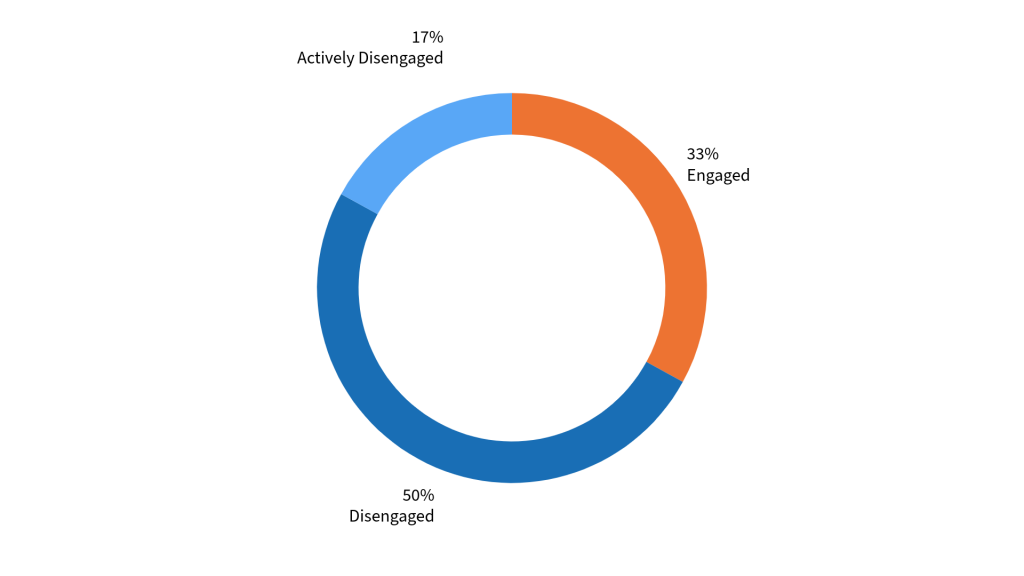
Yet the upside of solving this crisis is undeniable. Longitudinal studies comparing high-engagement business units to low-engagement ones prove a powerful multiplier effect, offering a clear financial incentive for strategic action:
-
+21% Profitability: Highly engaged teams achieve significantly better financial outcomes and contribute directly to market outperformance.
-
+17% Productivity: The discretionary effort generated by an engaged workforce translates directly into measurably higher individual and team output.
-
-51% Lower Turnover: In low-turnover organizations, high engagement drastically reduces departures, protecting intellectual capital and mitigating the massive hidden costs of replacement and retraining.

This undeniable return on investment proves that mindset is the new metric of performance. The core challenge for the executive suite is not funding the next digital tool but fundamentally changing the organization’s relationship with its people’s minds. This conversation is not about morale. It is about managing the asset that secures all other financial gains.
The Neuroscientific Diagnosis: Why Change Fails
To lead this pivot effectively, we must first understand the fundamental human mechanics that drive success and resistance. The process of human performance is cyclical: We Receive Information, Process It, and Express It. The source of the modern crisis is found in a profound neurological bottleneck.
The Problem of Cognitive Overload
The sheer volume of digital life has overwhelmed our fundamental ability to focus. Neuroscientific research shows the human brain receives approximately 11 million bits of information every second through sensory input. However, our conscious mind can process only a minuscule 40 to 50 bits of that information. This disparity is the root of today’s workplace anxiety.
With our conscious attention saturated, the other 11 million bits are processed unconsciously. In the modern, highly optimized, and algorithmically curated digital world, this means our unconscious processes (our perception of reality) are continuously directed by external streams of information. This includes everything from negative industry news and coworker burnout to the relentless pings of instant messaging. This exponential, filtered data stream drives anxiety, fatigue, and cognitive friction, resulting in workplace stress. As the statistics confirm, 50% of U.S. employees report experiencing stress often, a destructive force that degrades all forms of organizational capacity.
The Cost of Operating Outside the Innate Self
This environment forces employees away from their Innate Self, the biological, natural way they are wired to receive, process, and express information. Based on pioneering research, every individual has unique preferences (visual, auditory, kinesthetic) that define their optimal learning and communication mode.
When a leader, often unknowingly, forces an employee (whose innate style is visual and holistic) to operate primarily in a non-visual, highly analytical, and verbal mode, their brain is pushed into what I call Resistance Functioning.
Resistance Functioning is not just a descriptive term. It is a demonstrable state of neurological stress characterized by low energy and high effort. This state is the single biggest cause of organizational change fatigue and passive resistance. When employees must constantly fight their own wiring to perform tasks, energy is drained, productivity plummets, and stress becomes endemic. The widely cited 70% project failure rate is merely the inevitable organizational manifestation of millions of individual minds operating in a state of perpetual Resistance Functioning. The cost is too high to ignore.
The Liability of Cognitive Debt
In the pursuit of efficiency and outsourcing simple cognitive tasks to technology, we incur a devastating liability: Cognitive Debt. This is the accumulated price of substituting high-effort, deeply engaging thought processes with low-effort, low-learning consumption of technology-derived or AI digital summaries.
Degraded Capacity: Over-reliance on AI and digital scaffolding reduces the neural activity and connectivity associated with critical thinking, memory encoding, and synthesis. We become superior at inputting queries but inferior at challenging the output, generating novel ideas, or synthesizing information across domains.
The AI Blind Spot: We use AI to eliminate cognitive busywork, but unless that freed-up capacity is deliberately reinvested into high-effort human synthesis, the core intellectual muscle atrophies. This Cognitive Debt is the ultimate threat to innovation and long-term strategic resilience.
Replanting the Flag in 2026: The Three Mandates

To reverse Cognitive Debt and build an organization resilient enough for constant change, leaders must Replant the Flag around three strategic, operational mandates. This establishes the new philosophy of Mindset Metrics.
Mandate 1: Prioritize Deep Understanding
The first step is to halt generic, one-size-fits-all HR strategies and commit to knowing your people as you know your numbers. You must gather the deep data that informs all subsequent strategies.
-
Map the Flow State. Move beyond old HR data. Find out how every person is innately wired (their unique thinking styles and processing modes) to stop draining energy with “learned habits.” Design work that taps into the Innate Self, maximizing their energy, flow, and output. This creates the new Mindset Metrics Inventory.
-
Take the Psychological Pulse. Replace guesswork with precision. Gain real-time insight into the specific, local sources of stress, energy, and belonging unique to each team and manager. By pinpointing these drivers, you replace slow, annual feedback with data that allows for precise, human-centered action and intervention.
-
Proactively Manage Change. You must assess where mistrust and change fatigue are highest within the organization before launching an initiative. By creating a Human Risk Register, you convert potential passive resistance into active readiness, providing targeted support where and when it’s genuinely needed.
Mandate 2: Manage Trust and Belonging as P&L Assets
Trust and Belonging are the core social pillars that secure commitment, discretionary effort, and the capacity to change. This is the Psychological Mandate that directly counters the 70% project failure rate.
-
Build Trust Architects. The manager is the single most critical factor in securing commitment. We must elevate managers to be Trust architects, training them not just on process, but on vulnerability and empathy to secure team commitment. This ensures that every employee feels safe enough to be their authentic self, allowing Belonging (the #1 global driver) to flourish.
-
Secure the ROI of Commitment. By nurturing a culture of safety, you directly target the high financial risks of turnover and burnout. Leaders must commit to this: Empowerment through trust is the most efficient and adaptive leadership system possible, freeing managers and teams to focus on impact, not oversight.
-
The Mandate of Cultivation: The leader’s job shifts from Control to Cultivation. This means providing the psychological ground where people can take risks, offer feedback, and contribute fully without fear of reprisal.
Mandate 3: Enforce Cognitive Resilience
Leaders must establish a powerful defense strategy to protect the organization’s long-term intellectual capacity from the silent degradation of Cognitive Debt.
-
Mandate Strategic Friction. This is how we pay down Cognitive Debt. We must introduce intentional friction, such as scheduling low-tech, unplugged work sessions and mandating time for human synthesis and critique. We force the mind off of autopilot to rebuild the crucial neural pathways required for problem-solving.
-
AI for Delegation, Not Dependency. Define the organizational relationship with technology clearly. AI must be our tool for Delegation, eliminating the low-energy tasks that drain capacity. We must reject Dependency, which replaces human critical thinking, guaranteeing that our talent remains superior at asking the right, innovative questions.
-
The Future Defense: By committing to this, we protect the Human Cognitive Capital that drives breakthrough innovation, ensuring the organization does not become a mere consumer of standardized AI output.
Conclusion: The Cognitive Imperative
The central challenge of the next decade is managing the human mind under pressure. We are past the point where we can afford to treat people as fungible units of labor or simply delegate the problem to HR.
The organizational mindset must shift from Metrics to Mindset. The leaders who will dominate the next era will be those who successfully Replant the Flag. They will accept the Mindset Metrics philosophy, treating human thinking as a strategic asset that must be secured, managed, and defended with the same rigor we apply to financial or technological capital.
This is the ultimate strategic pivot: Master the mind, secure the organization, and win the future.