
Introduction: Leadership in an Age of Accelerated Pressure
Organizations today operate in an environment defined by speed, volatility, and continuous ambiguity. Technology cycles are shorter. Market signals are louder. Stakeholders expect more visibility and faster reaction times. Teams are distributed. Communication is instant. Decision-making windows are narrow. And beneath all this complexity lies a deeper, systemic truth: people within organizations are struggling to process change at the speed at which they are being asked to respond.
This gap between organizational velocity and human capacity creates a secondary pressure that few leaders are prepared for—an emotional undertow that influences judgment long before analysis begins. As explored in The Hidden Variable: Understanding Emotional Current, the emotional life of an organization shapes outcomes in ways leaders underestimate. What leaders say, how they say it, and who absorbs the emotional weight of change determine whether systems become coherent or reactive.
In Article 1 – The Hidden Variable: Understanding Your Organization’s Emotional Current, it was revealed that every organization operates within a shared emotional current. In this Article, we focus on the leader’s role within that current: the ability to maintain clarity when the system becomes overwhelmed. In systems theory, this capability is known as differentiation. In practice, it is the most critical determinant of whether leaders can sustain sound judgment under pressure.
Differentiation is not personality. It is not confidence. It is not charisma. It is a discipline: the capacity to remain connected to others while maintaining enough emotional and cognitive independence to think clearly, act deliberately, and lead without being pulled into the reactivity of the system around them. Differentiation is a leader’s internal stabilizer.
“A leader’s greatest influence is the calm they bring into a reactive system.”
As organizations absorb more pressure, from technology, from markets, from cultural shifts, the leaders who thrive will not be the ones who know the most, delegate the best, or communicate the most persuasively. They will be the ones who can hold position, maintain perspective, regulate emotion, and model coherence when the system around them begins to slip. This is the core leadership advantage of the coming decade.
“Reactivity spreads fast. Steadiness spreads faster.”
The Concept of Differentiation in Modern Leadership
Differentiation originates in the work of Dr. Murray Bowen, and was later expanded by Edwin Fiedman, observed that under stress, people tend to collapse into one of two reactive states: fusion (over-involvement in others’ emotions) or cutoff (emotional withdrawal). Both responses reduce clarity. Both diminish judgment. And both are amplified inside groups.
In organizational contexts, fusion often appears as over-functioning, leaders who absorb everyone’s anxiety, rush to fix problems prematurely, or become hyperactive in the face of uncertainty. Cutoff occurs as the opposite: leaders who distance themselves, avoid difficult conversations, or delay decisions out of fear of conflict. These patterns are predictable, and they spread. When a leader fuses, the system fuses. When a leader cuts off, the system fragments.
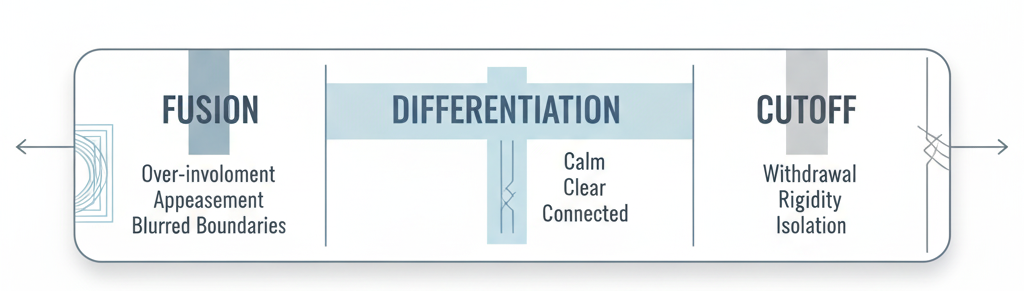
Differentiation, by contrast, is the capacity to stay connected while staying grounded in principle. The differentiated leader can hear others’ emotions without becoming governed by them. They can absorb pressure without converting it into urgency. They can hold steady enough that the people around them recalibrate. In Bowen’s original work, differentiation was viewed as a developmental capability. In modern organizations, it has become a strategic one.
Differentiation is not detachment. It is not emotional distance. Nor is it stoic performance. Differentiation is the integration of two abilities: to remain present in relationships and to remain anchored in one’s own thinking under stress. This combination, connection plus clarity, is rare. Many leaders can maintain calm by disconnecting emotionally. Others can maintain connection while losing clarity. The differentiated leader does both simultaneously and, in doing so, stabilizes the emotional current of the system.
“Differentiation is clarity without distance and connection without compliance.”
The Neuroscience of Clear Thinking Under Pressure
The biological basis for differentiation is well-established. When people perceive threat, psychological or physical, the amygdala activates within milliseconds, launching a cascade of emotional and physiological responses: increased heart rate, narrowed attention, reduced curiosity, and a bias toward rapid, defensive action. These responses served early humans well; they serve modern leaders poorly.
Effective leadership in complex systems relies on the prefrontal cortex, the region responsible for executive function, long-term thinking, and emotional regulation. Differentiation aligns with the prefrontal cortex’s ability to stay online even when stress is present. Leaders who can regulate their physiological response to pressure can maintain access to the full range of cognitive resources: pattern recognition, empathy, big-picture thinking, and nuance.
Differentiation, therefore, has a neurological signature:
- Lower cortisol response to ambiguity
- Higher activation of regulatory circuits
- Greater integration between emotional and cognitive centers
- Improved ability to reframe threat signals
In organizational settings, this neurological stability becomes contagious. People unconsciously mirror the calm, or anxiety, of their leaders. A differentiated leader helps others regulate simply by maintaining composure and clarity. In this way, differentiation becomes a form of distributed cognitive advantage: clear thinking spreads. When the leader stabilizes emotionally, the system stabilizes cognitively.
How Differentiation Functions Inside Organizations
Differentiation is not only internal. It shapes organizational behavior. When a leader is differentiated, the system behaves differently. Clarity increases. Communication sharpens. Decision-making becomes less performative and more substantive. Pressure no longer hijacks the process.
Three dynamics illustrate how differentiation functions in complex systems:
- Differentiation interrupts reactivity. Organizations under stress tend to polarize. People cluster around extremes, optimism vs. pessimism, action vs. hesitation, control vs. chaos. Differentiated leaders interrupt this pattern by slowing the pace, asking clarifying questions, and anchoring decisions to principle rather than pressure.
- Differentiation reduces emotional contagion. In reactive systems, anxiety spreads quickly. One ambiguous comment from a senior executive can ripple across an entire organization in hours. Differentiated leaders reduce emotional contagion by providing context, containing speculation, and creating enough clarity that people stop inventing their own narratives.
- Differentiation strengthens coherence. Coherence—the degree to which people share understanding and direction—depends heavily on leadership presence. When leaders maintain clarity under pressure, organizations maintain clarity under pressure. Differentiation creates the conditions for strategic alignment.
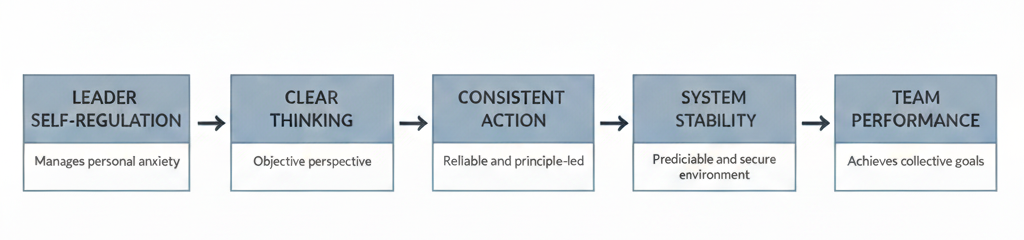
These dynamics make differentiation a force multiplier. It does not merely protect leaders from stress; it protects the system from absorbing unnecessary emotional volatility. In an era where uncertainty is the norm, that stability becomes a competitive advantage.
“Most leadership failures are not strategic; they are emotional.”
Case Study: The Merger After the Downturn
After the post-COVID mortgage banking downturn, marked by falling volumes, tight margins, and industry-wide consolidation, a mid-sized lender completed a merger to stabilize production and reduce costs. A veteran mortgage banking executive, experienced in multiple acquisitions, was asked to lead the integration.
She immediately sensed a shift in the emotional current: quiet meetings, guarded comments, and two legacy organizations politely protecting their old workflows. One side favored centralized underwriting with strict controls; the other relied on decentralized speed. Without a unifying logic, normal process differences turned into tension. Teams interpreted systemic mismatch as personal conflict, and workarounds began forming in the shadows. They were picking sides.
Instead of reacting to the tension or forcing alignment, she did the opposite; she slowed the system down. Drawing on experience, she paused integration activities and convened leaders. Calmly and without defensiveness, she asked some questions most leaders avoid:
- “What does it feel like to be working here right now?”
- “What are people actually thinking and saying in the spaces where leadership isn’t present?”
- “What uncertainties or worries are shaping how people show up right now?”
Because she held steady, others could be honest. The answers surfaced immediately: fear of redundancy, uncertainty about decision authority, confusion about priorities, and suspicion that the merger was driven more by cost pressure than strategy. Naming the emotional current reduced its influence. People stopped defending the past and began engaging the future.
From there, she rebuilt the integration around clarity: shared decision criteria, predictable communication rhythms, and a single guiding question, “What operating model does this merged company need for this market?” Within weeks, conversations shifted from “their process vs. our process” to “the model we’re building.” Turn-times stabilized, cross-functional friction eased, and the organization regained momentum.
The merger didn’t become easy. But because she stayed grounded, the system became clear enough to move. Over the next few months, the alignment improved, and they were able to grow the business.
“When the leader holds steady, the system gains the capacity to think.”
Differentiation as an Organizational Capability
Differentiation begins with individuals, but it scales through culture. Organizations can develop collective differentiation by designing systems that reward clarity, principle-driven action, and thoughtful reflection rather than reactivity.
Four organizational conditions cultivate differentiation at scale:
- Principle-based decision frameworks.When decisions are grounded in shared principles rather than personality or pressure, individuals rely less on emotional reactivity and more on collective reasoning. Clear principles decentralize differentiation.
- Consistent communication patterns.Predictability in tone, timing, and transparency reduces unnecessary anxiety. When people know how information will be shared, they spend less energy interpreting ambiguity.
- Structured pauses for sense-making.Organizations that build reflection into their rhythms—quarterly resets, debrief cycles, strategic rewinds—create space for differentiation to develop. Pause strengthens perspective.
- Leadership modeling. People learn how to behave from the emotional posture of those above them. When leaders demonstrate differentiation, it becomes part of the system’s operating language.
When these conditions exist, differentiation shifts from an individual trait to an organizational advantage. The company becomes more thoughtful under pressure, not less. It becomes more collaborative, not more territorial. It becomes more strategic, not more reactive.
“You can’t regulate a system you’re absorbed into.”
The Cost of Low Differentiation
Low differentiation is not always visible, but its effects are unmistakable:
- Decision cycles slow down because leaders are managing politics rather than priorities.
- Innovation declines because people avoid risks that might activate emotional backlash.
- Communication becomes guarded, performative, or overly polite.
- Conflict becomes personal or is avoided entirely.
- Strategy oscillates between extremes—overreach followed by overcorrection.
Most organizations misdiagnose these symptoms. They implement new processes, introduce new tools, or reorganize reporting lines. Yet none of these interventions resolve the underlying issue: the system cannot think clearly because its leaders cannot think clearly inside the system.
Low differentiation is a cognitive tax. It reduces the bandwidth available for high-quality thinking and replaces it with emotional management. It shifts the organization’s energy from progress to protection. Over time, the organization becomes more compliant than creative—a dangerous trajectory in fast-moving environments.
Differentiation in the Era of AI and Accelerated Change
AI has introduced a new source of systemic pressure: speed. Tools that shorten analysis cycles, automate decision pathways, and accelerate execution can produce immense value. But they also increase emotional demand. When technology accelerates the pace of work, humans must accelerate the pace of meaning-making. Most organizations are not designed for this.
Differentiated leaders bridge this gap. They create coherence between technological acceleration and human interpretation. They ensure that speed does not eclipse clarity. They prevent the organization from mistaking urgency for strategy. And they help people move from fear (“AI will replace me”) to possibility (“AI can extend my capability”).
In this way, differentiation becomes an essential leadership competency in the age of AI. It anchors the emotional current of the organization while the technical current accelerates. Without that anchor, organizations will gain capacity but lose coherence.
Why Differentiation Matters Now
Differentiation has always mattered in leadership. But it matters more now because the conditions that undermine clear thinking have increased dramatically:
- Information is abundant, but context is scarce.
- Pressure is constant, but meaning is intermittent.
- Change is rapi,d but interpretation is slow.
- Emotion is amplified through digital channels.
- Workforce trust is more fragile than in any era of modern business.
What Leaders Can Do
Leaders cannot eliminate these forces. But they can determine how their organizations absorb them. Differentiation is the mechanism through which leaders convert environmental pressure into internal clarity. It is the skill that prevents organizational anxiety from becoming organizational dysfunction.
Differentiated leaders create workplaces where people can think deeply, act responsibly, and collaborate authentically—even when uncertainty is high. They produce trust not by offering perfect answers, but by modeling steady thinking. They stabilize the emotional current so others can contribute their best.
Conclusion: Holding Position When It Matters Most
The next era of leadership will not reward the fastest decision-makers or the most charismatic communicators. It will reward those who can remain grounded when systems become reactive, who can interpret complexity without collapsing into urgency, and who can maintain connection without losing clarity.
“Differentiated leaders don’t rise above pressure; they think clearly within it.”
Differentiation is the architecture of that capability. It enables leaders to think clearly when their organizations cannot. It strengthens teams by reducing unnecessary emotional friction. It builds trust by making leadership predictable during unpredictable times. And it prepares organizations to meet the demands of a world where pressure will continue to rise.
Takeaways
- Slow the system before you push it. A brief pause often reveals what urgency hides.
- Name the uncertainty. Clear acknowledgment lowers the emotional temperature immediately.
- Separate reaction from reality. Respond to data; stay steady with emotion.
- Set shared decision criteria. People align faster when they understand the logic behind choices.
- Create predictable communication rhythms. Consistency calms a reactive system.
- Look for patterns, not personalities. Most conflict is systemic, not personal.
- Use emotional current as data. Ask regularly, “What’s the energy in your area right now?”
- Reconnect decisions to purpose. People follow meaning longer than they follow metrics.
- Stay connected while staying clear. Hold your position without withdrawing or overpowering.
- Protect your thinking time. A calm leader creates a calm system.
If Article 1 established that every organization carries an emotional current, This, Article 2, makes the case that leaders must become regulators of that current. Article 3 will extend this argument further: once leaders understand the emotional current and practice differentiation, they can adopt a true systems mindset, seeing patterns rather than problems and designing coherence rather than enforcing control.
Differentiation is the leadership advantage that allows all of this to happen.