
Part Three of The Hidden Forces of Organizational Performance
Introduction: Why the System Mindset Matters Now
Organizations today are operating in conditions of speed and pressure unlike anything leaders have experienced before. Technology accelerates expectations faster than people can adapt. Hybrid work fragments communication. Emotional fatigue accumulates across teams. Priorities shift quickly, often without the time needed for proper sense-making. Under these circumstances, even experienced leaders feel overwhelmed by the number of issues demanding attention.
What makes this moment especially difficult is not the volume of challenges but their interconnected nature. Modern organizations behave less like linear hierarchies and more like dynamic, interdependent systems. They respond to pressure. They transmit emotion. They compensate for gaps. They amplify uncertainty. And when tension increases, they reveal patterns long before they reveal metrics.
Yet leaders often respond to this complexity with tools designed for simpler times. They coach individuals. They restructure teams. They escalate accountability. They address what is visible and immediate… the conflicts, misunderstandings, missed deadlines, or friction between departments, without examining the system that produces those issues in the first place.
Article 1 showed that every organization carries an Emotional Current—a flow of pressure that shapes behavior beneath the surface. Article 2 demonstrated that differentiated leaders regulate that current by remaining calm, clear, and connected in the face of reactivity. This final article completes the trilogy by introducing the capability that turns emotional steadiness into strategic advantage: the System Mindset, the ability to see patterns rather than personalities, relationships rather than roles, and causes rather than symptoms.
The System Mindset is not a conceptual theory. It is a practical, disciplined way of seeing the organization that allows leaders to intervene where leverage actually exists.
“Leaders who think in systems do not look for someone to blame. They look for the pattern that made the outcome predictable.”
The Leadership Blind Spot: Solving Individual Problems in a Systemic World

Every leader has lived a version of this experience: two senior leaders cannot align, and the tension spreads across their teams. A department resists a new process, and the delay impacts multiple parts of the business. A team begins missing deadlines, and frustration grows. Communication feels disjointed, meetings become tense, and everyone seems to be working harder without moving faster.
In most organizations, these issues are interpreted through a personal lens. A leader is labeled resistant, disengaged, or overloaded. A manager is told to communicate more clearly. A team is described as having a “culture problem.” Interventions focus on individual coaching, performance adjustments, or interpersonal mediation.
These actions often produce short-term relief. But the relief rarely lasts because the root cause remains untouched. The behavior reappears in a different leader, a different team, or a different project because it was never about the individual in the first place.
People do not operate independently. They operate in conditions shaped by workflow design, decision clarity, communication rhythms, emotional tone, historical patterns, structural incentives, and leadership behavior. When the system produces confusion, friction, or anxiety, people behave accordingly.
This is the leadership blind spot: addressing individuals when the system is what needs attention.
Why Systems Matter More Now
The modern organization is defined by rapid change and interdependency. Workflows are no longer contained within vertical structures; decisions cross functions, geographies, and time zones. Emotional pressure moves through teams much faster than information does. Technology accelerates output but also increases individuals’ cognitive load. Hybrid environments create ambiguity about where decisions actually live.
Under such conditions, organizational patterns emerge quickly. Leaders see them in everyday situations: when teams avoid specific topics because the last discussion ended with conflict; when email threads become defensive because no one is certain who owns the next step; when meetings multiply because alignment is unclear; when people quietly work around processes that no longer match the reality of the work.
These are systemic signals. They reveal something about how the organization distributes pressure, information, and responsibility.
The System Mindset helps leaders read these signals accurately. Instead of reacting to the behavior, they step back to understand the structure that is producing it.
Bowen’s Insight: Emotional Logic Governs Systems
Bowen’s family systems theory remains one of the most powerful frameworks for understanding organizational behavior because it begins with a fundamental principle: systems operate according to emotional logic, not rational logic. Pressure, uncertainty, and ambiguity spread through groups in predictable ways. When a system is overloaded with emotional pressure, it compensates by producing recurring patterns—over-functioning and under-functioning, triangulation, projection, or cutoff.
These same structures appear in business environments. Leaders over-function when they absorb work to reduce tension. Managers under-function when emotional pressure causes them to withdraw. People triangulate through side conversations when direct communication feels risky. Teams cut off from each other when tension is high or priorities are unclear. None of this is evidence of personal weakness—it is evidence of systemic pressure.
This is the shift the System Mindset enables: Behavior is not judged. It is understood.
“Most conflict isn’t personal. It’s the system asking for clarity.”
From Describing People to Describing Patterns
A defining marker of system maturity is how leaders describe what they see. Leaders without a systemic lens describe individuals. Leaders with a System Mindset describe patterns.
“She’s disengaged” becomes “The workload is unclear and expectations keep shifting.” “He’s resistant” becomes “The system amplifies anxiety when priorities change rapidly.” “They can’t work together” becomes “The structure creates competing incentives.”
Descriptions determine interventions. Interventions determine outcomes. When leaders describe issues as personal, they intervene personally—coaching, correcting, or reallocating. When leaders describe issues as patterns, they intervene structurally—clarifying ownership, stabilizing emotional current, aligning incentives, or redesigning workflows.
This shift in language produces a shift in leverage. Structural interventions reshape behavior not by force, but by realigning the conditions in which people operate.
The Neuroscience Behind Systems Thinking

Systems thinking is not just an intellectual skill—it is a neurological discipline. Under stress, the brain narrows. The amygdala activates. Attention contracts. Thinking becomes linear, reactive, and judgment-oriented. The brain searches for certainty, and the easiest certainty to grasp is blame.
Blame is cognitively efficient. It simplifies a complex system into a single point of failure. But it prevents leaders from seeing the real forces at work.
To think systemically, the prefrontal cortex must remain engaged—capable of tracking relationships, sequences, and interdependencies. This requires emotional regulation. Leaders cannot diagnose systems when they are emotionally absorbed by them.
This is why Emotional Current (Article 1) and Differentiation (Article 2) are prerequisites. Emotional stability expands cognitive capacity. Differentiation allows leaders to stay connected without being consumed. Only then can the brain remain clear enough to interpret systemic patterns.
Systems thinking is emotional composure made visible in cognition.
How Systems Reveal Themselves
Systems never hide their behavior. They reveal themselves in recurring patterns that leaders can learn to recognize. You see it when a team consistently avoids certain conversations because the emotional tone surrounding those topics has become too charged. You see it when cross-functional handoffs break down in the same place every quarter. You see it when people begin working around formal processes because the real decision-making structure is different from what’s documented. You see it when the emotional tone of one leader begins to show up in the language of an entire department.
Chronic problems that survive multiple reorganizations are almost always systemic. Recurring breakdowns in the same workflow are almost always structural. Emotional patterns that spread across teams are almost always signals of a system under pressure.
The System Mindset teaches leaders to view these not as failures of individuals but as expressions of the system’s emotional and operational logic.
Case Study: The Pattern That Was Never About the People
In 2024, a financial services firm in Texas entered a period of accelerated growth. The market was expanding. Client demand was steady. Revenue was climbing. But tension between the sales and delivery functions escalated rapidly. Meetings became strained. Deadlines slipped. Communication grew more defensive. The two department heads, each experienced and respected, were increasingly reactive toward one another.
Leadership labeled the issue a personality conflict. They attempted mediation. They adjusted roles. They increased executive involvement. They provided coaching to both leaders. But nothing changed. The tension resurfaced in conversations, meetings, and projects.
Eventually, the CEO brought us in to look at the problem systemically. Within a short period, we identified the underlying pattern: sales was incentivized to move quickly and maximize volume, while delivery was measured on precision and quality. The faster sales moved, the more delivery struggled. The more delivery struggled, the more sales escalated. The emotional current running between the two teams intensified the friction, making the conflict feel personal even though the cause was structural.
Once the pattern was named, we helped the organization redesign the operating model. Sales and delivery began forecasting together. Planning cycles were synchronized. Incentives were aligned around customer outcomes rather than departmental metrics. Communication rhythms were standardized. With the changes, the conflict dissolved. Not because the individuals changed, but because the structure that created the tension was reengineered.
The issue was never about the people. It was about the system.
“They did not fix the individuals. They fixed the pattern that made the behavior inevitable.”
The System Mindset as an Organizational Capability
The System Mindset strengthens not only individual leaders but entire organizations. High-performing organizations embed systemic thinking into their culture. They create transparency so people understand how their work connects to the whole. They structure decision rights and workflows around the reality of how work actually happens, not how the org chart was originally designed. They normalize root-cause conversations rather than treating recurring issues as personal failures. They pause to reflect, not because something is wrong, but because reflection is a necessary input for clarity.
These organizations have the emotional bandwidth to think. Emotional Current is stable. Leaders model differentiation. Information flows cleanly. Patterns become visible. And because patterns are visible, they become changeable.
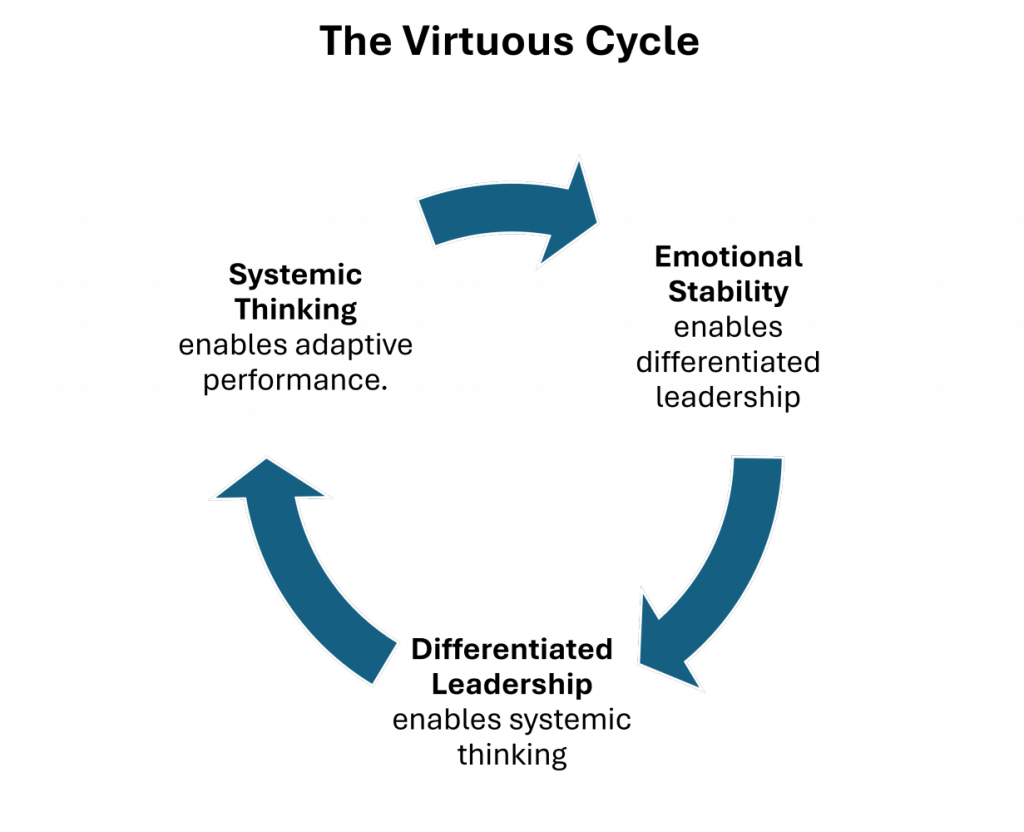
This produces a Virtuous Cycle: emotional stability enables differentiated leadership; differentiated leadership enables systemic thinking; systemic thinking enables adaptive performance.
The Cost of Leading Without a System Mindset
Organizations that do not think systemically pay a significant price. High-capacity individuals become overloaded because the system unconsciously shifts pressure to them. Under-functioning becomes normalized in others because emotional pressure makes engagement feel risky. Behavioral issues reappear in new roles or new teams because the underlying pattern remains unchanged. Reactive communication spreads through the organization, reducing trust and increasing misinterpretation. Reorganizations fail to produce meaningful improvement because the structure is adjusted, but the system is not understood. Strategic decisions drift toward tension reduction rather than value creation.
Without the System Mindset, leaders see fragments. With it, they see the whole.
Why the System Mindset Is Essential in This Era
Three forces make systemic leadership essential today. AI accelerates execution but cannot interpret emotional dynamics, meaning leaders must provide the systemic context that technology cannot. Hybrid work scatters communication, making patterns harder to see and easier to misread. Emotional load increases across teams as cognitive demands rise, and systems either absorb this pressure or amplify it. Leaders who think systemically are better equipped to stabilize their organizations under these conditions.
Organizations that develop the System Mindset gain a durable advantage. They see problems earlier, intervene more effectively, and build environments where people can think clearly and act boldly.
The Leader’s Work: See the Pattern. Name the Pattern. Shift the Pattern.
Systemic leaders excel in three disciplines. First, they see the pattern. They observe behavior without personalizing it. They notice sequences, emotional echoes, recurring interactions, and structural gaps. They watch how the system distributes pressure and responsibility.
Second, they name the pattern. Naming reduces anxiety because it gives form to what people feel but cannot yet articulate. Naming transforms diffuse emotion into usable information. It turns confusion into clarity.
Third, they shift the pattern. They intervene not at the point of pain but at the point of leverage. Their interventions are often upstream, small clarifications, structural adjustments, communication resets, and decision-rights alignment. These subtle changes produce outsized effects by altering the system’s underlying logic.
This is the essence of systemic leadership: visible calm, perceptive seeing, precise naming, and targeted intervention.
Takeaways
- Shift attention from individuals to interdependencies. Behavior flows from system conditions.
- Name patterns early. It reduces anxiety and prevents reactivity from spreading.
- Look for what repeats. Recurrence is the system revealing its logic.
- Intervene upstream. Structural clarity drives behavioral change.
- Stabilize the emotional current first. Calm systems think more clearly.
- Treat behavior as information. It describes the system’s state, not personal character.
- Use shared language to create coherence. When people describe patterns the same way, alignment accelerates.
Conclusion: Leading the Whole, Not the Parts
The Trilogy of Emotional Current, Differentiation, and the System Mindset offers a cohesive pathway for modern leadership.
- Article 1 showed that organizations operate as emotional ecosystems.
- Article 2 demonstrated that leaders regulate those ecosystems through clarity and composure.
- Article 3 completes the arc by giving leaders the lens required to understand and shift the patterns that shape performance.
In a world defined by complexity, leaders who see systems hold a decisive advantage. They do not simply respond to surface-level behavior; they understand the forces that create it. They do not manage people one at a time—they shape the conditions under which people can think, collaborate, and perform.
Leaders who master the System Mindset create organizations capable of clarity under pressure, coherence under change, and resilience under uncertainty. They don’t just solve problems.
They shape the environment that prevents them.