The Shift from Episodic Change to Continuous Pressure
For much of the modern corporate era, change was episodic. It arrived in waves, often driven by discrete events such as mergers, market expansions, leadership transitions, or major technology upgrades. Between these moments, organizations were afforded time to stabilize. Leaders could assess what had changed, restore equilibrium, and reestablish operating norms before the next disruption arrived.
That rhythm no longer exists.

Today, pressure is not something organizations move through. It is something they operate within. Markets shift faster than planning cycles. Technology introduces new capabilities before norms or guardrails have time to form. Customer expectations evolve continuously. Regulatory, social, and labor dynamics apply force even when an organization is not actively pursuing transformation.
Importantly, many organizations experience this pressure without initiating change themselves. Vendors adopt new systems. Customers behave differently. Competitors alter cost structures or service models. AI and automation introduce new questions about judgment, accountability, and value creation. These forces enter the system regardless of leadership intent.
The result is a fundamental shift in the leadership problem.
Leadership is no longer primarily about managing transitions between stable states. It is about maintaining coherence when stability itself is no longer the baseline. Systems are asked to continuously absorb novelty, often without clear recovery periods. Sense-making must occur in parallel with execution. Decision making happens under conditions of incomplete information, not as an exception, but as the norm.
This environment exposes a quiet limitation in many established leadership models. Most were designed for optimization, not absorption. They assumed that clarity could be restored before the next decision cycle. They treated uncertainty as temporary rather than structural.
Under continuous pressure, those assumptions no longer hold.
What begins to fail is not effort or commitment, but the underlying operating logic through which leaders interpret signals, prioritize action, and reinforce behavior. The algorithm that once produced alignment now produces friction. The same leadership patterns that created stability now amplify stress.
The problem is not that leaders resist change. It is that many leadership algorithms were designed for a world where change arrived differently.
Why Existing Algorithms Break Under Pressure
Established leadership algorithms are rarely accidental. They are built deliberately over time through experience, success, and reinforcement. They reward behaviors that previously worked. They encode assumptions about decision authority, pace, risk, and control. They produce results, often for years.
That success is precisely what makes them fragile under new conditions.
Most legacy leadership algorithms prioritize predictability, efficiency, and control. They emphasize clarity through hierarchy, consistency through standardization, and performance through optimization. In stable or moderately dynamic environments, these qualities scale well. They reduce variance. They simplify coordination. They allow organizations to execute reliably.
Under sustained pressure, however, these same algorithms begin to degrade.
Decision-making narrows as leaders attempt to reduce uncertainty rather than interpret it. Authority is re-centralized when speed is prioritized over learning. Psychological safety erodes not because leaders intend harm, but because urgency compresses tolerance for exploration and dissent. Complexity is treated as noise rather than signal.
These failures rarely announce themselves. They surface indirectly through behavior.
Teams hesitate before raising concerns. Middle managers compensate quietly to protect outcomes. People default to what is safest rather than what is most truthful. Innovation slows not because of a lack of ideas, but because of uncertainty about what will be supported under pressure.
From the outside, these dynamics are often labeled cultural or executional problems. Engagement declines. Change initiatives stall. Strategy feels disconnected from reality. Leaders respond with additional communication, structural changes, or performance pressure.
But the root issue is architectural.
The algorithm governing how the organization processes pressure has not been redesigned. It is still optimized for a different environment. As pressure increases, the system does not become more adaptive. It becomes more defensive.
This is why algorithms fail quietly. They continue producing outputs, but those outputs shift from coherence to compensation. Energy is redirected toward interpretation, protection, and local optimization rather than shared progress.
In this sense, algorithmic failure is not breakdown. It is misalignment between design and environment.
Algorithm Redesign Is Not Transformation Theater
When leaders recognize that something is no longer working, the instinctive response is to initiate change. Strategies are refreshed. Structures are adjusted. Technologies are introduced. Cultural narratives are updated. In some cases, leadership teams are reorganized.
These efforts are often necessary. They are also frequently insufficient.
Most organizational change initiatives focus on visible artifacts rather than invisible logic. They alter what the organization does without altering how the organization decides, interprets, or responds under pressure. The underlying algorithm remains intact.
This is why many transformations generate initial momentum but fail to sustain impact. Behavior changes temporarily. Compliance increases. New language circulates. But when pressure rises, the system reverts to its original operating logic.
True algorithm redesign is fundamentally different from transformation theater.
It requires leaders to examine how decisions are made when stakes are high, not when conditions are calm. It requires confronting which behaviors are protected, which are penalized, and which are quietly tolerated. It demands clarity about how disagreement is handled, how uncertainty is processed, and how authority shifts under stress.
Most importantly, it requires consistency.
Algorithms learn through reinforcement, not declaration. If leaders articulate new priorities but behave differently when outcomes are threatened, the system resolves the contradiction in favor of behavior. This is not resistance. It is coherence seeking.
Redesign, then, is not about announcing change. It is about altering the patterns that teach the organization how to function when it matters most.
This is uncomfortable work. It exposes leadership habits that once felt effective but now constrain adaptability. It requires leaders to interrupt patterns they may personally rely on. It demands patience in moments when urgency tempts a return to the old ways.
Yet without this work, organizations remain trapped between aspiration and reality. They pursue new outcomes with old logic. They ask people to adapt without changing the conditions that govern adaptation.
In environments defined by continuous pressure, this gap widens quickly.
Change that does not alter the algorithm produces movement without direction. Activity without coherence. And ultimately, fatigue without progress.
Coherence as the Primary Design Objective
In environments of continuous pressure, coherence becomes the scarce resource. Not speed. Not alignment statements. Not even innovation. Coherence.
Coherence is what allows people to act without waiting for permission. It is the condition in which individuals understand the system’s logic well enough to make decisions locally without fragmenting direction, trust, or intent. When coherence is present, organizations absorb pressure without panic. When it is absent, even small disruptions feel destabilizing.
Many leaders misinterpret coherence as consensus or uniformity. It is neither. Coherence does not eliminate disagreement or variance. It provides a shared frame within which disagreement can occur productively. It allows multiple execution paths to coexist without eroding shared purpose.
From an algorithmic perspective, coherence is the output that matters most under pressure.
It emerges when the rules governing decision-making, prioritization, and response remain intelligible even as conditions change. People may not always agree with outcomes, but they understand how those outcomes were reached. They know what signals matter. They know which tradeoffs are acceptable. They know how to recover when uncertainty is high.
This is why coherence must be designed intentionally. It does not emerge solely from communication. It is reinforced through behavior that remains stable even when context shifts.
When leaders react inconsistently under pressure, coherence degrades quickly. A decision reclaimed here. An exception granted there. A value set aside in the name of urgency. Each instance teaches the system that the rules are conditional. Over time, people stop relying on stated logic and begin relying on pattern recognition.
Under continuous pressure, this pattern recognition accelerates. The system learns faster, not slower.
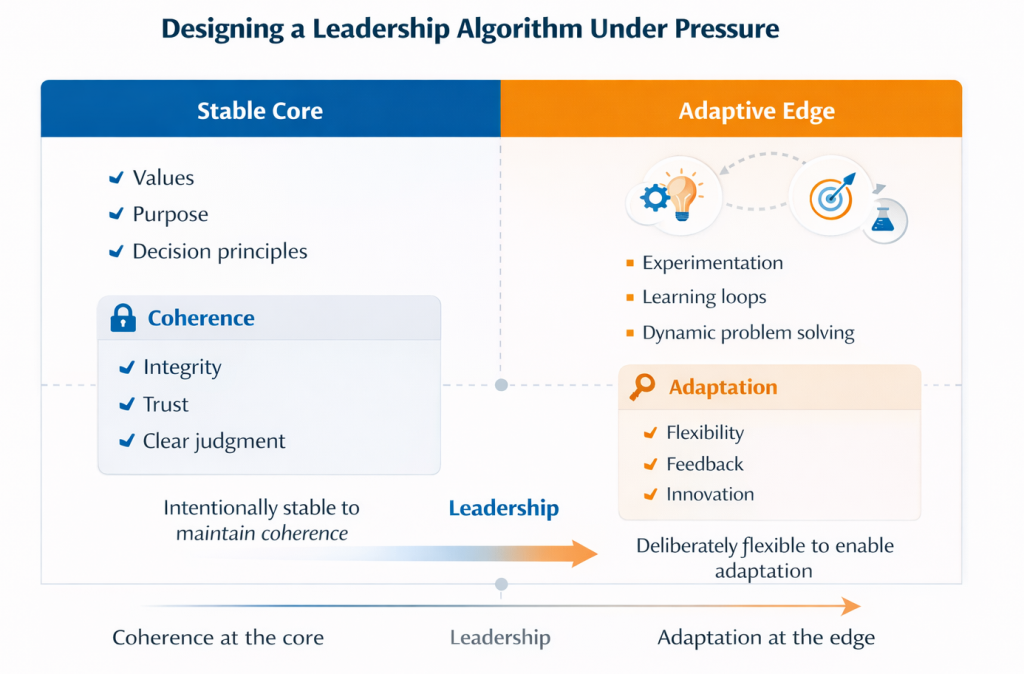
Coherence, therefore, requires leaders to identify which elements of the algorithm must remain stable regardless of external conditions. These anchors act as reference points. They reduce cognitive load. They allow people to orient themselves even when novelty is constant.
Without these anchors, adaptation becomes improvisation. And improvisation at scale creates fragmentation.
Designing for coherence is not about resisting change. It is about ensuring that change occurs within an intelligible structure. It is the difference between a system that flexes and one that fractures.
Designing Algorithms at Multiple Levels
One of the most common mistakes leaders make when attempting redesign is treating the algorithm as a single, monolithic construct. In reality, effective leadership algorithms operate at multiple levels simultaneously.
At the most foundational level is the base algorithm. This includes values, decision principles, and definitions of success and failure. It governs how the organization interprets purpose and accountability. This layer should change slowly, if at all. It provides continuity across disruption.
When leaders alter this layer frequently or ambiguously, trust erodes. People lose confidence in what the organization stands for. Stability dissolves.
Above this sits the adaptive algorithm. This layer governs how the organization approaches novelty. How new tools are evaluated. How experimentation is encouraged or constrained. How learning occurs without undermining performance. This layer must be flexible by design. It absorbs variation without destabilizing the base.
Many organizations struggle here because they attempt to force adaptability through the base algorithm. They rewrite values or restructure authority rather than design explicit adaptive mechanisms. The result is confusion rather than agility.
The third layer is the disruption algorithm. This governs behavior under extreme conditions. Crises. Market shocks. Rapid technological shifts. Moments where established processes no longer apply cleanly. This layer is rarely articulated explicitly, yet it exerts enormous influence.
In the absence of intentional design, disruption algorithms default to fear-based logic. Authority recentralizes. Dissent narrows. Short-term outcomes override long-term coherence. People optimize for survival rather than contribution.
Leaders often believe these behaviors are unavoidable under pressure. They are not. They are learned.
Organizations can be trained to handle disruption differently. But only if leaders model and reinforce those patterns before disruption occurs. Under pressure, systems revert to what has already been practiced.
Designing across these layers allows leaders to preserve coherence while enabling adaptation. The base provides stability. The adaptive layer allows learning. The disruption layer prevents collapse.
Crucially, these layers must be aligned. If the adaptive algorithm contradicts the base, people experience anxiety. If the disruption algorithm violates stated values, trust erodes rapidly. Consistency across layers is what allows the system to absorb pressure without losing integrity.
This multi-level design discipline is where experienced leaders hold a unique responsibility. Their history gives them leverage. Their behavior carries weight. Small deviations at the top ripple quickly through the system.
In this sense, algorithm redesign is not an abstract exercise. It is a daily leadership practice. Leaders reinforce or erode coherence every time they choose how to respond to pressure.
The question is not whether the algorithm will change. Continuous pressure guarantees that it will.
The question is whether that change will be intentional.
External Pressure Is Not the Problem. Uninterpreted Pressure Is.
By the time most leaders recognize the need to redesign their leadership algorithm, pressure is already present. Markets have shifted. Technology has introduced new capabilities. Competitors have altered expectations. Regulatory, social, or economic forces have changed the terrain.
Leaders often experience this moment as loss of control. In response, they attempt to accelerate decision-making, compress communication, or centralize authority. These reactions feel rational. They are also precisely how coherence is lost.
External pressure does not destabilize organizations on its own. What destabilizes organizations is the absence of a shared mechanism for interpretation.
“Pressure does not break systems. Uninterpreted pressure does.”
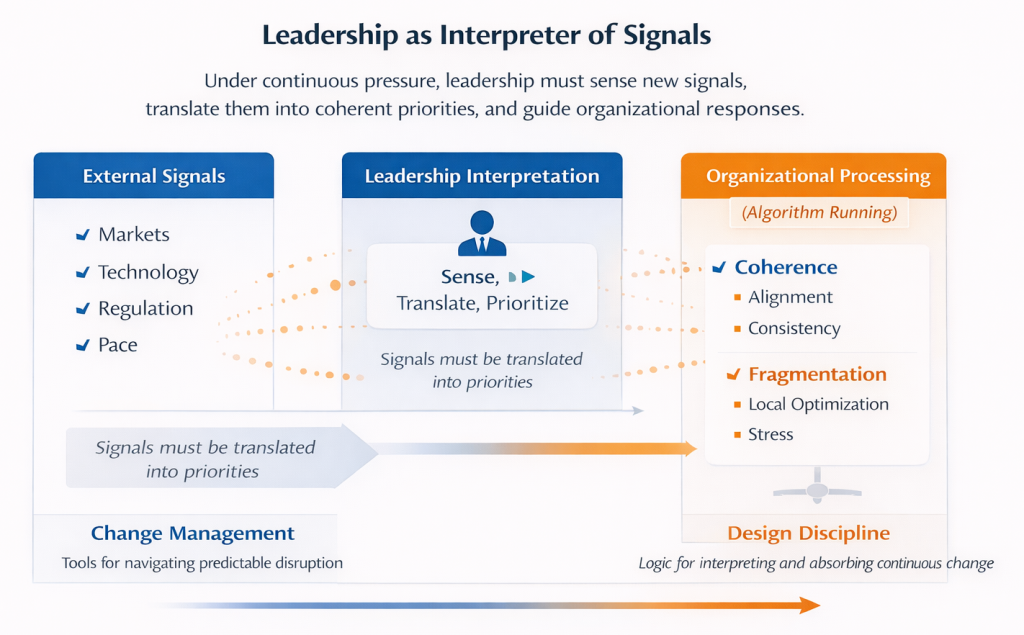
Pressure introduces new signals into the system. New data. New tools. New constraints. New opportunities. The organization does not struggle because these signals exist. It struggles because people do not know how to interpret them relative to existing priorities, values, and boundaries.
This is where leadership design becomes decisive.
Experienced leaders cannot prevent pressure from entering the system. They can determine how it is translated. When leaders fail to explain how new signals should be weighed, people fill the gap themselves. They over-index on speed. They chase novelty. They protect local interests. They optimize for what feels immediately rewarded.
This behavior is not resistance. It is adaptation.
Technology provides a clear example. Artificial intelligence is not simply a new tool. It is a new signal category. It changes the economics of speed, scale, and substitution. Without leadership interpretation, organizations treat it either as a threat to be avoided or a shortcut to be exploited.
Both responses fragment coherence.
Purposeful design requires leaders to explain where new signals fit within the algorithm. What they change. What they do not. What remains stable. What must adapt. And which tradeoffs are now acceptable that were not before.
“New technology is not a strategy. It is a signal that must be interpreted by leadership design.”
This translation cannot be delegated entirely. It is not a communication task. It is an authorship task.
Leaders must decide which parts of the system are allowed to flex and which must remain anchored. Without that decision, pressure becomes noise. Noise erodes trust. Trust erosion forces control. Control suppresses learning.
The result is a brittle organization that appears busy but lacks direction.
“Design begins when leaders decide what must remain stable and what is allowed to adapt.”
Leadership as Ongoing Algorithm Stewardship
The final shift required of experienced leaders is subtle but profound.
Leadership is no longer about installing or correcting the algorithm. It is about stewarding it.
“Once an algorithm is running, leadership becomes stewardship, not control.”
Stewardship acknowledges that the algorithm is always running. It recognizes that leaders are never outside the system they shape. Every reaction, delay, exception, and emphasis becomes part of the logic others follow.
This makes leadership less dramatic and more exacting.
Algorithm stewardship requires leaders to observe the system with discipline. To notice where coherence is holding and where it is thinning. To distinguish between healthy adaptation and quiet erosion. To intervene not with force, but with signal.
Small interventions matter most. A question asked consistently. A decision boundary reinforced publicly. A value upheld when it would be easier to bypass. These actions recalibrate interpretation without destabilizing the system.
This is why authority alone is insufficient. Authority can compel behavior briefly. It cannot sustain coherence. Only pattern reinforcement can do that.
Stewardship also requires leaders to examine their own internal algorithms. Long-standing habits. Default responses under pressure. Preferences that once served the organization but now constrain it.
“Organizations do not just learn what leaders say. They learn how leaders react under pressure.”
Experienced leaders often underestimate how deeply their personal logic has been absorbed by the system. The organization has learned how to read them. Tone shifts are noticed. Attention changes are decoded. Silence is interpreted.
Redesign therefore begins internally. Leaders must ask not only what the organization needs to change, but what they themselves must interrupt.
This is uncomfortable work. It is also unavoidable.
In environments of continuous change, leadership credibility is no longer built through vision statements or structural reorganizations. It is built through visible consistency in how leaders interpret pressure.
The system watches closely.
“Leadership is not a role performed. It is a logic installed, reinforced, and redesigned over time.”
Closing Synthesis: Leadership as Design Under Pressure
Across this trilogy, leadership has been examined from three interrelated perspectives.
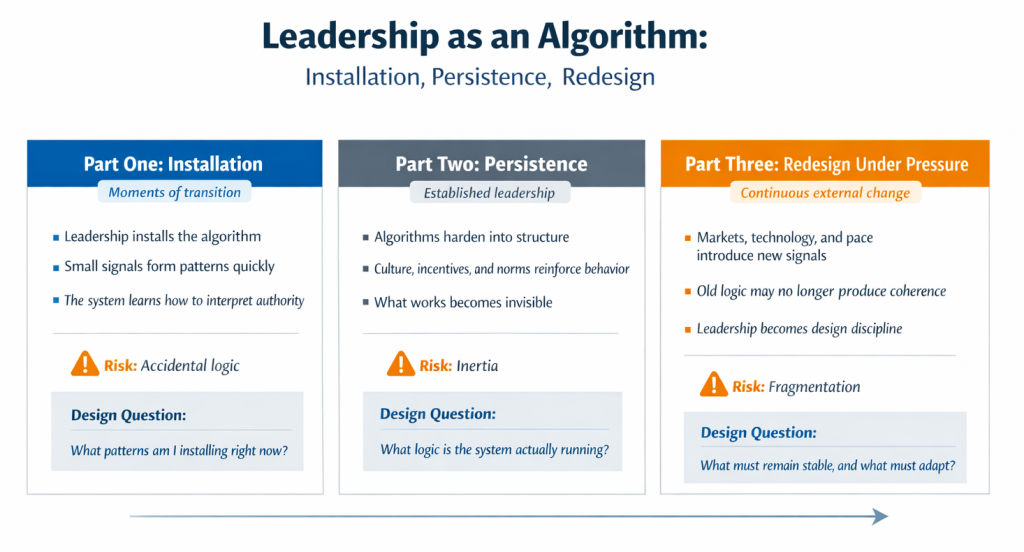
In Part One, leadership was shown to initialize systems through behavior rather than intent. Especially during transition, small signals install operating logic that shapes how organizations think and act.
In Part Two, that logic was shown to persist. Over time, leadership algorithms harden into structure. They create stability. They also create inertia. What once felt intentional becomes automatic.
In Part Three, leadership has been reframed again. Not as correction or control, but as design under pressure.
Taken together, these perspectives reveal a responsibility many leaders underestimate.
Leadership is not only about direction. It is about interpretation. It is not only about change. It is about coherence across change. It is not only about performance. It is about the conditions that sustain performance.
Organizations do not break down because people lack capability. They break down because the algorithm becomes unintelligible under pressure.
When leaders design intentionally, systems remain readable. People understand how to think, decide, and act even as the environment accelerates. Diversity of thought can coexist with unity of purpose. Change can occur without eroding trust.
When leaders do not design intentionally, systems still adapt. But they adapt around fear, speed, and local optimization. Coherence gives way to compensation. Alignment becomes fragile. Execution becomes brittle.
The difference between these outcomes is not charisma, authority, or intelligence.
It is authorship.
Leadership, at its core, is an architectural act. Leaders decide what the system will absorb, what it will resist, and how it will translate pressure into action. These decisions are made every day, whether consciously or not.
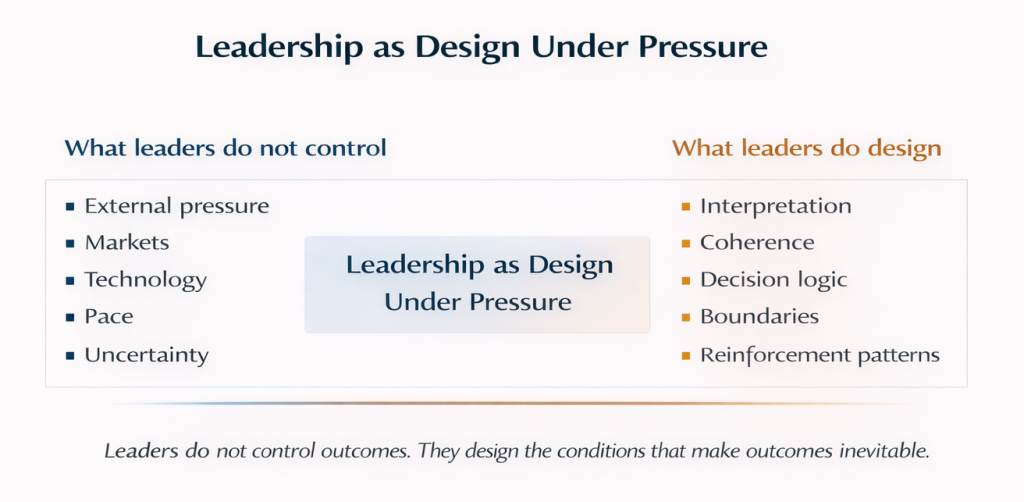
The final obligation of leadership is not to control outcomes.
It is to design the conditions that make the right outcomes inevitable.
Leadership is an algorithm.
And systems do exactly what they are trained to do.
“Leaders do not control outcomes. They design the conditions that make outcomes inevitable.”