
Part Two: When the System Is Already Running
In Part One, we established that leadership installs an operating logic through repeated behavior, one that teaches organizations how to interpret signals, make decisions, and allocate trust under pressure. Part Two begins where that insight becomes more difficult and more consequential. For established leaders, the challenge is no longer initialization. The system is already running. Its patterns are deeply embedded, its assumptions largely invisible, and its responses well rehearsed. What once felt intentional has become normalized. The very consistency that once produced coherence now determines whether the organization can adapt. In an environment of continuous change, leadership effectiveness depends less on setting direction than on recognizing when the logic that made the organization successful is now constraining its ability to respond. This is the work of mature leadership: examining the patterns one has already created, understanding how they shape perception and behavior, and deliberately recalibrating the system without destabilizing it.
Recalibrating a System That Is Already Running
When Consistency Becomes Constraint
Part One established a central premise: leadership behavior installs an operating logic into the organization. That logic governs how people interpret pressure, make decisions, handle disagreement, and decide what matters when tradeoffs arise. In the early stages of leadership transitions, this logic is visible, fluid, and actively forming.
For established leaders, the challenge is different.
The algorithm is no longer being installed. It is already running. And in many cases, it has been running successfully for years.
This success creates a paradox. The very consistency that once produced coherence now begins to function as constraint. Patterns that once stabilized the system begin to narrow its field of view. Decision rules that once accelerated progress start to slow adaptation. What was once clarity becomes rigidity, not because the leader has changed, but because the environment has.
This is where experienced leaders often struggle to diagnose what is happening. Performance may still be acceptable. Trust may still exist. The organization may even be profitable. Yet momentum feels harder to sustain. Change initiatives encounter unexpected resistance. People hesitate in ways they did not before. Energy dissipates around new ideas that once would have gained traction quickly.
Established systems do not resist change. They resist incoherence.
The instinctive response is often to look outward. Market conditions. Talent shifts. Technology cycles. Customer expectations. These forces are real, but they are not the full explanation.
More often, the system is doing exactly what it was trained to do.
Leadership algorithms reward consistency. Over time, consistency becomes expectation. Expectations harden into assumptions. Assumptions quietly become rules. Once this happens, behavior no longer feels chosen. It feels required.
This is not failure. It is the natural outcome of a stable algorithm operating over time.
The risk for established leaders is not that their algorithm stops working. It worked so well that it became invisible.
Leader History as System Inertia
Every experienced leader carries an internal algorithm of their own.
This algorithm is shaped by years of decisions, successes, mistakes, recoveries, and tradeoffs. It reflects what worked under pressure, what failed publicly, what earned trust, and what created risk. Over time, it becomes a highly efficient shortcut for decision-making. Leaders no longer consciously evaluate every situation. They recognize patterns and respond.
This internal efficiency is a strength. It allows leaders to operate decisively. It reduces cognitive load. It enables speed.
It also transfers directly into the organization.
Over time, the leader’s internal algorithm becomes externalized. Decision rhythms become predictable. Risk tolerance becomes known. Escalation thresholds stabilize. People learn how long to wait, when to push, when to hold back, and which ideas will survive scrutiny.
The organization adapts around this logic.
This is how leader history becomes system inertia.
The system is not merely responding to formal processes or stated values. It is responding to accumulated behavioral evidence. What happened last time matters more than what is said this time. People do not ask what the leader believes. They ask what the leader has historically done in similar conditions.
This is why experienced leaders often encounter resistance they do not recognize as resistance. The organization is not opposing the leader. It is protecting itself from perceived risk based on prior learning.
This dynamic is especially pronounced when leaders attempt to introduce change that conflicts with their own historical patterns. The system experiences the proposal through the lens of past behavior. If past actions contradict current intent, people default to the algorithm they trust, not the message they hear.
The result is a quiet form of misalignment. Leaders believe they are being clear. The organization believes it is being prudent. Both are acting rationally according to different interpretations of the same algorithm.
This is why self-examination becomes unavoidable for established leaders. To understand the organization’s behavior, leaders must examine the decision logic they themselves have modeled over time. Not to assign blame. To surface the rules that are already in place.
Until that happens, attempts to change outcomes will collide with deeply embedded, logically consistent patterns from the system’s perspective.
Change Is No Longer Episodic
For much of modern organizational history, change was treated as an event.
New strategies were rolled out. Systems were implemented. Mergers were integrated. Leaders planned, communicated, executed, and then returned to a period of relative stability. Change management frameworks reflected this rhythm. Prepare, transition, stabilize.
That rhythm no longer exists.
Today, change is ambient. Even when organizations are not actively transforming themselves, the environment around them is. Vendors evolve. Customers shift expectations. Regulation adjusts. Technology advances. Optimization pressures increase. Each external movement introduces new signals into the organization, whether leaders intend it or not.
The effect is cumulative.
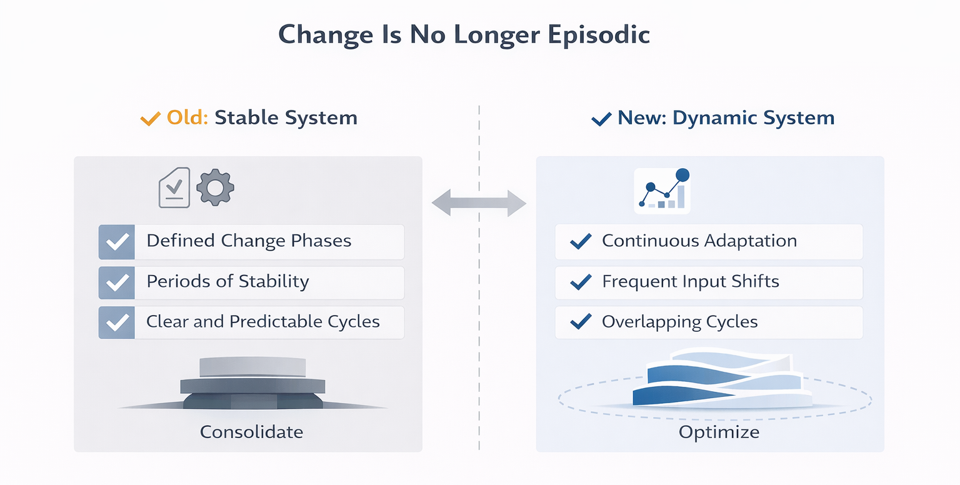
Organizations are no longer adapting occasionally. They are adapting continuously. The leadership algorithm is being stressed constantly by inputs it was not originally designed to process.
This shift matters because most leadership algorithms were built for a different operating context. They assumed periods of consolidation between waves of change. They relied on stable reference points. They rewarded efficiency and predictability.
In a continuously changing environment, those same characteristics can become liabilities.
When change becomes continuous, leadership logic must become adaptive by design.
Established leaders often sense this intuitively. Decisions feel heavier. Alignment takes longer. Communication must be repeated more frequently. What once felt like clarity now feels brittle. The system reacts more strongly to disruption. Emotional load increases even when performance metrics remain steady.
This is not because people are weaker or less capable. It is because the algorithm is absorbing more signal than it was designed to interpret.
Change management, in this context, is not a project. It is an algorithmic adjustment.
Leaders are no longer deciding whether to change. They are deciding how the system will process ongoing change without losing coherence. This requires a different discipline than episodic transformation. It requires leaders to examine not just what is changing, but also how the organization has historically learned to respond to change.
Without this examination, leaders risk pushing for outcomes that the current algorithm cannot support. The result is friction, fatigue, and diminishing returns.
The work of the established leader, then, is not to outpace change. It is to recalibrate the operating logic so the system can absorb change without fragmenting.
Multiple Levels of Operating Logic
As leadership algorithms mature, a single operating logic is no longer sufficient. What once worked as a unified set of principles and behaviors begins to strain under the weight of increased complexity.
This is not because the original algorithm was flawed. It is because environments evolve faster than static logic can accommodate.
Established leaders must begin thinking in terms of layered operating logic.
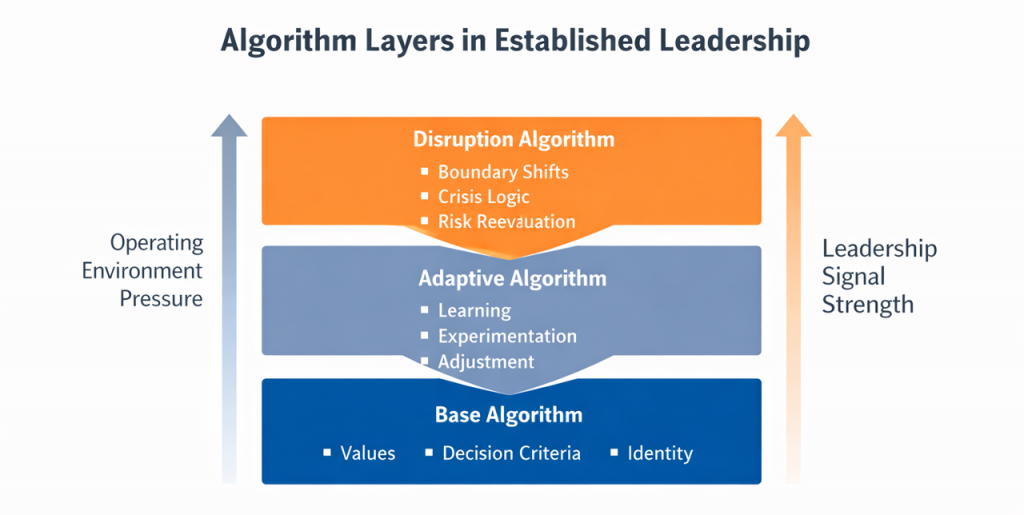
At the foundation sits the base algorithm. This is the most stable layer. It governs values, decision criteria, ethical boundaries, and the definition of success. It answers questions such as what matters most, how tradeoffs are resolved, and which principles are nonnegotiable. This layer should change slowly, if at all. It is the anchor that preserves identity and trust.
Above that sits an adaptive layer. This is where leaders introduce new ways of responding to novelty, ambiguity, and emerging conditions. This layer governs experimentation, learning cycles, and provisional decision-making. It allows the organization to engage with unfamiliar challenges without destabilizing the core.
A third layer becomes necessary during disruption. This layer governs behavior when existing assumptions no longer hold. It addresses conditions where boundaries must shift, priorities must be reweighted, and risk tolerance recalibrated. This is the layer that determines whether the organization freezes, fragments, or adapts under extreme pressure.
Most organizations operate with only one explicit algorithm. It is expected to handle everything. When disruption arrives, leaders attempt to stretch that logic beyond its capacity. Confusion follows, not because people resist change, but because they are operating without clear guidance on which rules apply.
Mature leadership involves clarifying which layer is active at any given time. People do not need certainty about outcomes. They need clarity about operating logic. When leaders fail to differentiate between stability, adaptation, and disruption, the system defaults to familiar patterns even when those patterns no longer serve.
Stability is not the absence of change. It is clarity about what should not change.
Coherence During Algorithmic Change
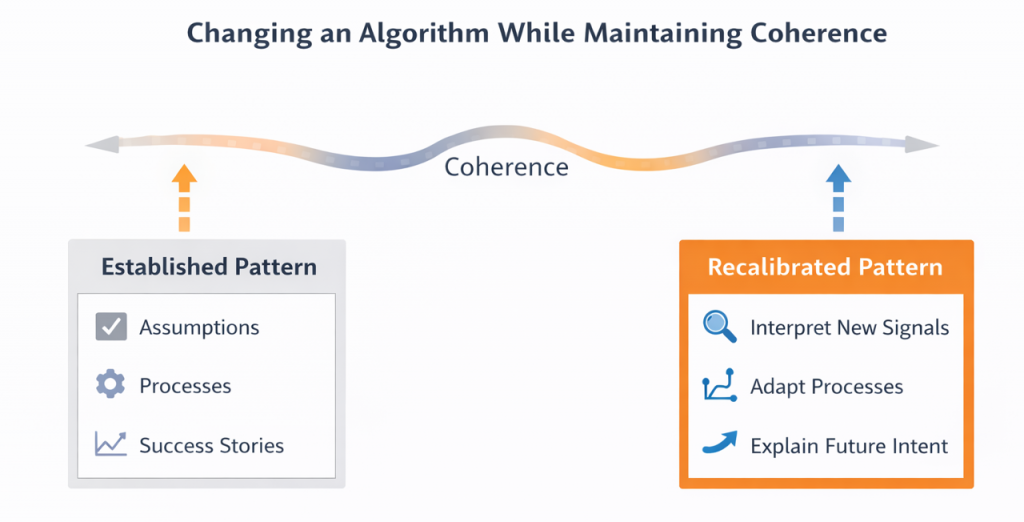
Changing an algorithm is not simply a matter of introducing new behaviors. It requires preserving coherence between what came before and what is emerging.
This is where many experienced leaders underestimate the work involved.
People do not experience change as discrete events. They experience it as a narrative. They ask whether the new direction honors the past, contradicts it, or renders it irrelevant. When that narrative is unclear, anxiety rises even when the change itself is necessary.
Coherence does not mean continuity of process. It means continuity of meaning.
Leaders must help people understand how the new operating logic connects to the old one. What remains true. What must change. Why previous approaches made sense then and why they must evolve now. Without this explanation, people experience change as arbitrary rather than adaptive.
In fast-moving environments, this work becomes harder. Changes occur closer together. Leaders feel pressure to move quickly. Yet the responsibility for coherence increases, not decreases. When change happens faster than interpretation, people disengage cognitively even if they comply behaviorally.
Algorithmic change that breaks coherence produces short-term movement and long-term fragility.
The burden of explanation falls squarely on leadership. It is not enough to announce new priorities or new tools. Leaders must articulate how the system should now think. Where old rules still apply. Where they no longer do. And how people should make decisions when signals conflict.
When coherence is maintained, people adapt more quickly than leaders expect. When it is not, resistance appears even among capable and committed teams.
New Signals and Signal Saturation
Modern leadership algorithms must now contend with a problem earlier generations rarely faced at this scale: signal saturation.
New signals are entering organizations continuously. Some come from familiar sources at faster speeds. Others are entirely novel. Artificial intelligence is a clear example. It introduces new capabilities, new risks, and new uncertainties simultaneously.
Signals do not destabilize systems simply because they are new. They destabilize systems when their magnitude and pace exceed the organization’s capacity to interpret them.
Impact is not linear. It compounds.
A moderate change introduced slowly can be absorbed. A moderate change introduced rapidly can overwhelm. A large change introduced rapidly can destabilize even healthy systems.
Leaders often focus on implementation. Less attention is paid to interpretation. People are expected to adapt without sufficient context. When this happens, fear fills the gaps. Productivity declines not because tools are ineffective, but because meaning is missing.
Established leaders must recognize that part of algorithmic leadership now involves signal translation. Leaders must slow meaning even when execution speeds up. They must explain what signals matter, which can be ignored, and how decisions should be made when signals conflict.
This work cannot be delegated entirely. People look to leadership to determine how seriously to take new inputs. Silence is interpreted as uncertainty. Overconfidence is interpreted as denial. Both destabilize the algorithm.
Effective leaders neither amplify nor suppress signals indiscriminately. They contextualize them. This preserves trust and cognitive capacity even as the environment accelerates.
Recalibration Without Destabilization
The most difficult work for established leaders is recalibration.
By the time an algorithm needs adjustment, it is already embedded in habits, expectations, and informal norms. Authority alone cannot overwrite it. Declarations are insufficient. Structural changes without behavioral consistency often backfire.
Recalibration requires leaders to deliberately and patiently interrupt patterns.
This begins with visible self-adjustment. When leaders change how they respond under pressure, the system notices immediately. When leaders slow decisions they previously rushed, invite dissent they previously closed down, or tolerate ambiguity they previously resolved quickly, the algorithm begins to shift.
Consistency matters more than intensity. Small, repeated signals reshape expectations more effectively than dramatic interventions.
Feedback mechanisms must also evolve. Leaders need earlier indicators of misalignment. Waiting for performance metrics delays correction. Listening for hesitation, workarounds, and silence provides faster insight into whether the new logic is being absorbed.
Signals do not destabilize organizations. Unexamined interpretations do.
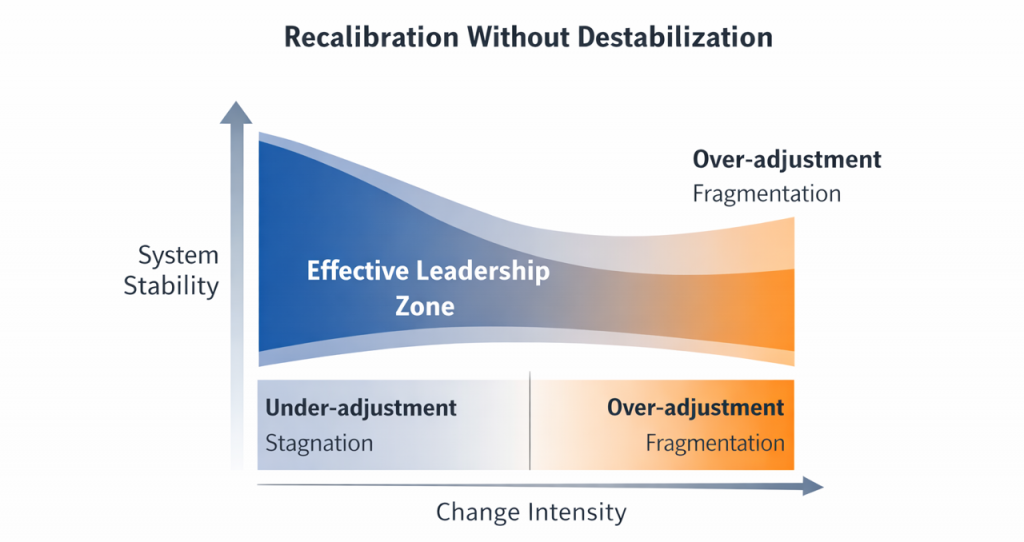
Importantly, recalibration does not mean destabilization. Leaders must preserve enough predictability to maintain trust. This balance is what distinguishes mature leadership. Too little change preserves stagnation. Too much change erodes coherence.
The goal is not to replace the algorithm entirely. It is to update it so the system can continue functioning under new conditions.
Closing Synthesis: The Discipline of Algorithmic Leadership
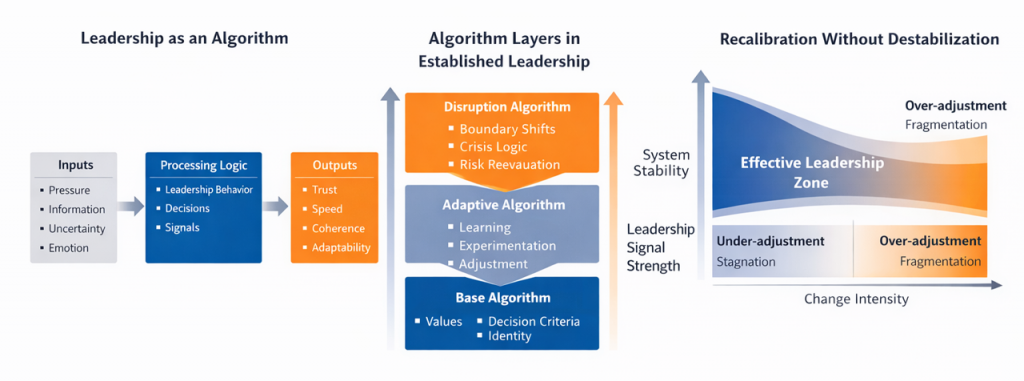
Part One established that leadership behavior installs an operating logic into organizations. Part Two extends that insight into a more demanding reality.
Once the algorithm is running, leadership responsibility changes.
For established leaders, the work is no longer installation. It is examination. Recalibration. Translation. Preservation of coherence under continuous pressure.
This work is harder than initial leadership. It requires confronting one’s own patterns. It requires slowing down to see what has become invisible. It requires patience in environments that reward speed.
Leadership maturity is not measured by control or charisma. It is measured by the ability to shape systems that can think, adapt, and remain coherent without constant intervention.
Organizations do not resist change because people are unwilling. They resist change because algorithms are reliable. Leaders who understand this do not fight resistance. They redesign the logic that produces it.
Leadership remains an algorithm.
And the most consequential leaders are those who know when, and how, to rewrite the code without breaking the system that depends on it.