
Seasonal Signals of Leadership — Part 3
The New Year is often treated as a symbolic reset. A fresh calendar. A convenient moment to announce new goals and accelerate execution.
But for most people, it is not merely symbolic. It is psychological.
Even in organizations that pride themselves on consistency, January feels different. People listen more closely. They reflect more honestly. They quietly reassess what the past year required of them and what they are willing to give to the year ahead. They begin to evaluate not only their goals but also their alignment with their work, their leaders, and the organization’s direction.
That shift is not accidental and not sentimental. It is rooted in how human beings experience time.
Certain moments naturally separate “what has been” from “what comes next.” The New Year is one of the few shared moments when people are already doing that work internally…reassessing priorities, reinterpreting effort, and deciding whether to recommit. Whether leaders engage that moment or not, it is already happening. The difference is whether leadership shapes the direction of that reset or leaves it to chance.
This is why leaders should care about this time of year.
“Leadership is not only exercised through decisions, but through timing. Certain moments invite clarity—and the New Year is one of them.”
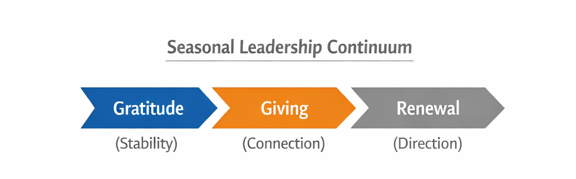
In the first two articles of this seasonal series, we explored gratitude and giving as leadership practices that stabilize people and strengthen systems. Gratitude helped people recognize what they carried. Giving restored humanity and balance as the year closed. The New Year introduces a different responsibility. It is the moment when reflection turns into direction, and when leadership either restores momentum with intention or allows the system to drift forward unresolved.
Renewal at the start of a new year is not a soft leadership gesture. It is a strategic and human necessity. It re-establishes direction, restores energy, and sets the conditions for sustained performance. Because people are naturally more open during this transition, leaders have a higher probability of creating real alignment now than they will later in the year.
The risk is equally real. January amplifies leadership signals. If leaders perform renewal without living it, if they announce goals without coherence, or if they remain silent while people are searching for clarity, the damage is not neutral. It accelerates disengagement, deepens cynicism, and erodes trust at precisely the moment when people are most attentive.
Why the New Year Changes How People Listen
Human beings do not experience time as a continuous stream. We experience it in chapters. Certain moments function as psychological thresholds that separate a “before” from an “after,” making reflection and change feel more possible. The New Year is one of the most powerful of these thresholds because it is shared, expected, and reinforced by long-standing cultural practice.
This does not mean people suddenly become disciplined or optimistic. It means the internal conditions are different. Attention widens. Identity becomes more flexible. People are more willing to reconsider assumptions about what matters, what is possible, and what they want from their effort.
Leaders do not create this openness. They inherit it.
The leadership question is whether that openness is used to restore clarity or allowed to dissipate under the weight of urgency. When leaders rush immediately into execution, they often mistake movement for alignment. When leaders pause long enough to orient people, they increase the likelihood that momentum will be sustained rather than forced.
January is not a time for motivational speeches. It is a time for stewardship.
“People and organizations both move through cycles. The New Year functions as a shared psychological reset, whether leaders acknowledge it or not.”
Organizations Are Seasonal, Whether They Admit It or Not
Organizations often present themselves as continuous systems, but they behave seasonally. They plan and measure in cycles. They close books. They set annual targets. They evaluate performance year over year. People feel those cycles even when no one names them.
January signals evaluation and expectation. It signals opportunity and judgment. It raises quiet questions about standing, direction, and belonging. When leaders do not intentionally shape those signals, ambiguity fills the gap, and it is rarely benign.
This is another reason leaders should care about this time of year. Silence is interpreted. If leaders do not re-establish direction, people assume drift. If leaders do not clarify priorities, people create their own narratives. Those narratives are rarely generous, and they often become self-fulfilling.
The New Year offers a brief opportunity to interrupt the default patterns of speed and pressure and to reset the environment before momentum resumes. That reset is not about slowing down. It is about restoring coherence so effort can be applied intelligently rather than reactively.
Renewal Is Reorientation, Not Rest
Renewal is often confused with rest. Rest matters, but it is not the leadership work.
The New Year is not only a pause between cycles. It is the beginning of a new one. People often arrive in January with a quiet desire to start again — not from zero, but with intention. They want the next chapter to feel different from the last, even if the work remains demanding.
Renewal meets that desire by restoring orientation.
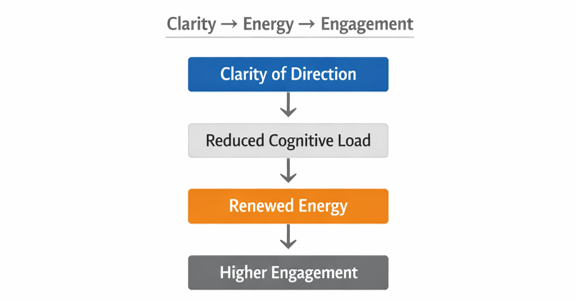
Reorientation reconnects effort to meaning. It clarifies what matters now. It reduces the cognitive friction that builds when priorities accumulate without resolution. When people can see where they are headed and why, energy reorganizes naturally around direction rather than endurance.
“During seasonal transitions, people look to leaders not for answers alone, but for orientation.”
This is why renewal restores energy without reducing ambition. It allows people to recommit voluntarily because the path ahead feels coherent.
A new year arrives automatically. A different year requires leadership.
Why Leaders Should Care: The Engagement Reality
This leadership window would matter even in healthy organizations. It matters more because many organizations are not healthy.
Employee engagement remains stubbornly low across industries, with a significant portion of the workforce disengaged or actively disengaged. These figures are not abstract. They show up daily as reduced discretionary effort, guarded communication, and quiet withdrawal.
Announcements or incentives do not solve disengagement. It is shaped by environment, clarity, and meaning. January matters because many employees are already evaluating those factors for themselves. They are setting personal goals. They are reconsidering professional direction. They are deciding whether the organization they work for supports the future they want or merely consumes their energy.
Leaders can align with that evaluation or ignore it. Ignoring it does not make it disappear. It simply ensures that the conclusions people draw are made without leadership guidance.
Hope is not a strategy.
What People Quietly Need at the Start of a New Cycle
The New Year does not produce a single emotional response. Some people feel hopeful. Some feel pressure. Some feel anxious. Some feel discouraged by what did not change.
Leadership is not about forcing a mood. It is about creating conditions.
At the start of a new cycle, most people need three things, even if they never articulate them directly. They need clarity about direction… where the organization is going and why. They need clarity about role and contribution, what is expected, and how success will be understood. And they need signals of steadiness and humanity, evidence that leadership recognizes the human cost of work and intends to lead responsibly.
These needs are not soft. They are functional. When people have clarity, they waste less energy guessing. When they understand how they fit, collaboration improves. When they feel seen, engagement stabilizes.
January is a moment when people are unusually open to receiving these signals. That openness is the opportunity.
Replanting the Flag and Reaffirming the Journey

Every year implicitly asks a leadership question: What matters most now?
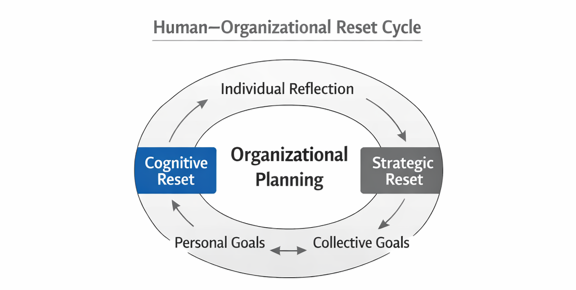
Replanting the flag is the act of answering that question clearly and credibly. Sometimes that means articulating a new direction. Sometimes it means reaffirming the journey already underway. What matters is not novelty, but coherence.
People need to know whether they are being asked to change course or to recommit. Leaders lose credibility when they imply one while practicing the other.
“The beginning of the year is not about creating momentum—it is about restoring direction.”
Replanting the flag is not a branding exercise. It is an act of judgment. It clarifies what will be prioritized, what will be protected, and what will no longer be true. It gives people a reference point they can carry into daily decisions.
Without that reference point, momentum becomes noise.
Reset the Environment Before You Ask for More Output
Strong renewal begins by resetting the environment before accelerating execution.
This means restoring baseline clarity — priorities, expectations, constraints, and decision logic, so people can orient before they are asked to perform. When leaders skip this step, momentum is built on confusion. When they honor it, momentum is built on alignment.
Resetting the environment also requires closing the prior chapter honestly. Not with a highlight reel, but with acknowledgment of what the year demanded and what it revealed. Unacknowledged experience becomes residue. Residue increases friction. Closure frees attention.
This is not about dwelling on the past. It is about preventing it from silently shaping the future.
Expand the View: Help People See the Terrain
Most employees operate inside a narrow slice of the organization. They see their tasks and immediate pressures, but not the full terrain — external forces, competitive realities, internal constraints, or strategic trade-offs.
When people cannot see the terrain, they interpret their experience personally. Decisions feel arbitrary. Pressure feels chaotic. Work becomes reactive.
One of the most valuable things a leader can do in January is widen that view. By placing the organization within its broader environment and clarifying the forces at play, leaders help people orient. Orientation restores agency. Agency restores engagement.
This is where renewal becomes energizing rather than exhausting.
Clarify Success, Clarify Failure
People cannot commit deeply to a year they do not understand.
Clarity about success is not micromanagement. It is shared expectation. It answers the questions people carry quietly about what excellence looks like, what will be rewarded, and what truly matters.
Clarifying failure is not threat. It is honesty. It defines what the organization cannot afford and what drift looks like before drift becomes culture.
Inconsistency erodes engagement faster than pressure. January is a chance to reduce that inconsistency by defining the year in terms people can actually use.
When Leaders Don’t Live It, the System Regresses
January heightens attention. People watch closely for alignment between what leaders say and what they do. When leaders declare priorities they do not intend to live, the damage is relational. Cynicism grows. Discretionary effort recedes. Trust erodes.
Silence carries consequences as well. When leaders do not set direction, people assume drift. When they do not clarify expectations, people fill the gap with their own narratives.
This is why the New Year is high-leverage leadership territory. Done well, it restores trust and mobilizes energy. Done poorly, it accelerates disengagement.
“When leaders articulate goals but fail to live them, the cost is not confusion—it is disengagement.”
Closing: A New Year Is a Leadership Responsibility
The New Year will come whether leaders use it or not. People will reassess their direction, their energy, and their willingness to commit, with or without leadership guidance.
That is why this moment matters.
It is a time when people are unusually open to clarity. When direction is easier to establish. When renewed energy can be mobilized without force. And when leadership signals carry more weight than they will later, once urgency returns and habits harden.
“Clarity reduces cognitive load. Reduced cognitive load restores energy. This is not motivation—it is human functioning.”
Renewal does not guarantee a better year. But the absence of renewal almost guarantees repetition, of fatigue, of misalignment, of quiet disengagement carried forward.
Leadership is not measured only by how momentum is sustained, but by how deliberately it is re-established. The New Year offers a rare opportunity to do that work with clarity, coherence, and humanity.
Those who recognize the moment can reset direction and restore commitment. Those who miss it will still move forward, just not together.
“That difference is not seasonal. It is leadership.”
Final Thoughts
As the year begins, leaders have a rare advantage: people are open. They are listening more closely, recalibrating their own goals, and watching for signals about what comes next. The question is not whether this moment matters…but whether it will be used. Leadership at the start of the year is not about urgency or ambition. It is about clarity, consistency, and credibility. What you name now, what you commit to now, and what you model in the weeks that follow will shape not only performance, but trust. This is the moment to replant the flag and then live by it.
Happy New Year.