
Opening: Where the Idea Came From
The idea for this article did not come from theory. It came from practice.
Over the past year, I have worked closely with several leaders stepping into significantly expanded roles. Three of them, in particular, were moving into senior positions with real scope: larger teams, broader decision authority, and increased visibility. Each was responsible not just for execution, but for shaping how people thought, decided, interacted, and carried pressure.
As we worked through their 90 to 180-day transition plans, a consistent pattern emerged. The formal plans looked solid. The priorities were clear. The organizational charts were correct. But something more fundamental kept surfacing in our conversations.
They were not just inheriting responsibilities. They were inheriting influence.
Every one of them would, intentionally or not, redefine how their organization experienced leadership. How people spoke in meetings. How safe it felt to raise concerns. How decisions were made when information was incomplete. How values showed up when tradeoffs became uncomfortable. How momentum was built or stalled.
The first ninety days mattered not because of the initiatives they would launch, but because of the tone they would set. Expectations would be formed quickly. Behaviors would be calibrated. Assumptions would harden. Long before performance reviews or strategy updates, the organization would be learning how to operate under them.
At a certain point in those discussions, we began talking not only about leadership traits, but also about the patterns those leaders would set in motion.
Not just who they wanted to be as leaders, but what the system would learn from their behavior. Read Silent Signals of Leadership
That is when the analogy became unavoidable.
What they were installing in those first ninety days was not just credibility or trust. They were installing an operating logic. A set of rules, reinforced through action, that would shape how the organization processed information, handled pressure, and decided what mattered.
In other words, they were installing an algorithm.
At first, this framing was useful primarily for new leaders. It gave them a concrete way to think about their responsibility. Not as performers or fixers, but as designers of the environment in which others would think and act.
But as the work continued, it became clear that this was not a transition-only issue.
Established leaders run algorithms too. They are just harder to see.
Over time, leadership behavior becomes normalized. Patterns fade into the background. What once felt intentional becomes invisible. The algorithm continues to run, shaping outcomes long after the leader has stopped actively thinking about it.
That realization widened the scope of the idea.
This is not an article about onboarding or early wins. It is an article about leadership as a structural force. About how leaders, through repeated behavior, shape the cognitive and emotional operating system of their organizations.
The first ninety days simply make that process easier to observe.
What follows is an exploration of leadership through this lens. Not as personality. Not as charisma. Not as inspiration alone. But as an algorithm that governs how organizations actually function.
Introduction: The Moment Where Leadership Becomes Structural
Leadership is often described in human terms: vision, presence, empathy, decisiveness, courage. These qualities matter. But they are not the most consequential thing a leader brings into an organization. What shapes outcomes more reliably is not who the leader is, but what the leader sets in motion.
“Leadership does not shape outcomes through intention alone. It shapes outcomes through the patterns it repeatedly reinforces.”
Every leader, whether they intend to or not, installs an operating logic into the systems they lead. Through words, behaviors, decisions, reactions, and silences, leaders define how work gets done, how risk is handled, how disagreement is expressed, how values are translated into action, and how people decide what matters when tradeoffs arise.
This operating logic functions much like an algorithm.
- It processes inputs.
- It establishes expectations.
- It rewards certain behaviors and discourages others.
- It adapts, or fails to adapt, based on feedback.
- And over time, it produces predictable outputs.
The most overlooked truth in leadership is that organizations do not follow strategy as much as they follow the algorithm imposed by leadership behavior. What leaders say they value matters far less than what the system learns actually works.
“Organizations do not follow strategy. They follow the logic they experience every day.”
This becomes especially visible during moments of transition. When a leader steps into a new role, particularly a senior one, the organization watches closely. Not for grand declarations, but for patterns. The first ninety days do not merely introduce a leader. They initialize the system.
“The first ninety days do not reveal who a leader is. They teach the system how to interpret them.”
What follows is not a checklist for new leaders. It is a reframing of leadership responsibility itself. Leadership is not only relational, strategic, or cultural. It is computational. Leaders shape how the organization thinks.
What an Algorithm Really Is
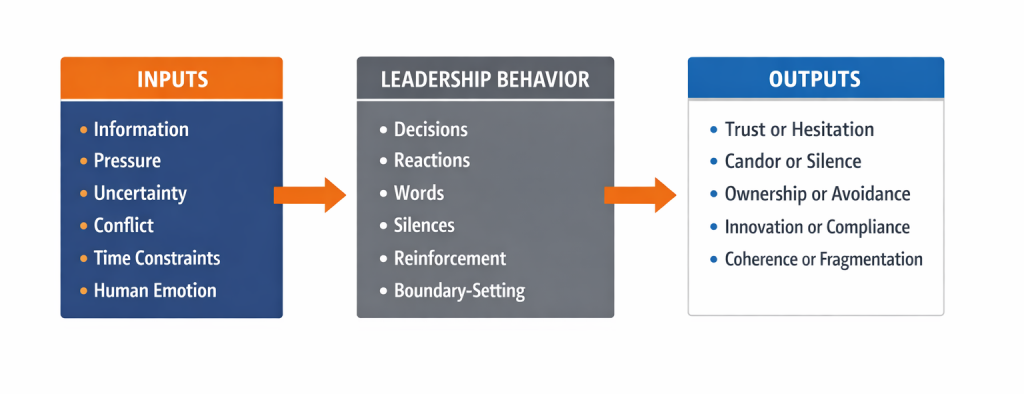
In technical terms, an algorithm is a defined set of rules or instructions that takes inputs, processes them through a series of steps, and produces outputs. Algorithms do not require intent. They require consistency. They do not care what someone believes. They reflect what actually happens.
Applied to leadership, the inputs are familiar:
- Information
- Pressure
- Uncertainty
- Conflict
- Time constraints
- Competing priorities
- Human emotion
The processing logic is shaped by leadership behavior:
- How decisions are made
- Who gets heard
- What gets escalated
- What gets ignored
- How mistakes are handled
- How values are enforced
- How ambiguity is treated
The outputs are what people experience every day:
- Speed or paralysis
- Trust or caution
- Candor or silence
- Ownership or avoidance
- Innovation or compliance
Every organization runs on an algorithm. The only question is whether it is intentional, coherent, and aligned with stated values, or accidental, fragmented, and driven by unexamined behavior.
“Some people (leaders) get up and their whole day is an accident.”
This distinction becomes critical when leaders assume new roles. In those moments, the algorithm is not only running. It is being rewritten.
The Expected Algorithm and the Actual Algorithm
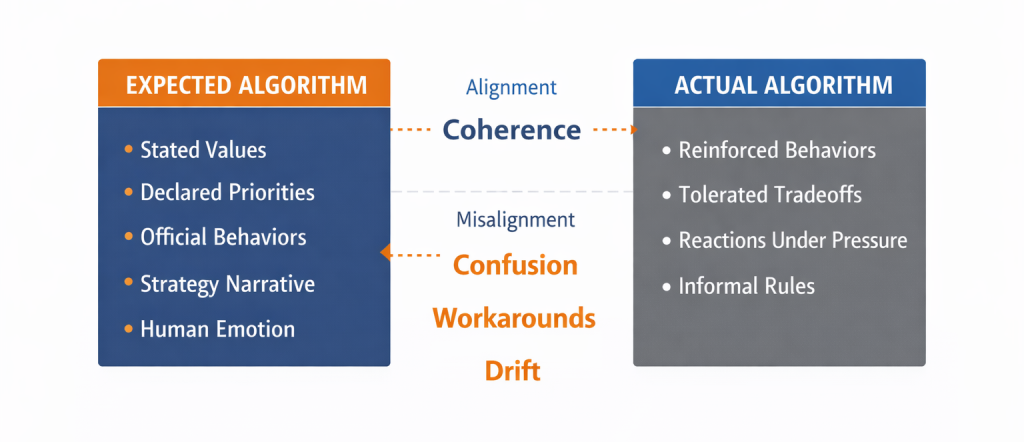
“The gap between the expected algorithm and the actual one is where trust erodes or coherence forms.”
Leaders usually carry an expected algorithm into a role.
This includes goals, priorities, values, and a mental model of how the organization should function. It often appears in strategy decks, kickoff meetings, or early communications. It is what leaders believe they are installing.
Alongside this, however, the organization rapidly learns the actual algorithm.
The actual algorithm is not what is said. It is what is reinforced. It is revealed through small, repeated signals:
- What happens when deadlines slip
- How disagreement is received
- Who gets protected under pressure
- Which tradeoffs are tolerated
- What gets rewarded when no one is watching
When the expected and actual algorithms align, coherence emerges. People understand the system’s rules. They know how to operate within it. They can make decisions without constant supervision because the logic is clear.
When they diverge, confusion follows. People hesitate. Trust erodes. Informal workarounds emerge. The organization begins compensating for uncertainty rather than advancing toward its goals.
Most leadership problems attributed to culture, engagement, or execution are, at their core, algorithm problems.
Leadership as Path, Not Control
Leadership algorithms operate across a journey. There is always a point of departure and a point of intent. There is an anticipated path between them. Rarely is it linear.
Effective leaders define not only the destination but also the acceptable boundaries of the journey. Within those boundaries, people have latitude. Outside them, clarity is required.
This balance between unity and diversity is often misunderstood. Unity does not require uniformity. It requires shared purpose, shared constraints, and shared understanding of what success and failure look like. Diversity of thought, method, and perspective thrives when the boundaries are clear.
“Unity comes from shared boundaries. Diversity comes from freedom within them.”
In algorithmic terms, leaders define:
- The objective function
- The constraints
- The feedback mechanisms
People contribute creativity, judgment, and local adaptation within that structure.
Problems arise when leaders violate their own constraints without explanation. When behavior falls outside the established boundaries and is left unaddressed, the algorithm degrades. The system no longer knows what rules apply. Doubt replaces confidence. Alignment becomes fragile.
Coherence is not enforced through control. It is maintained through consistency.
Why the First Ninety Days Matter Disproportionately
The first ninety days of a leadership transition carry an asymmetrical weight. This is not because leaders are expected to solve everything quickly. It is because systems are most plastic during moments of uncertainty.
People are actively scanning for signals:
- What matters here now
- What has changed
- What will stay the same
- How safe it is to speak
- How risk is treated
- How values show up under pressure
During this period, leaders are not simply learning the organization. The organization is learning the leader’s algorithm.
This learning does not happen through formal communication alone. It happens through tone, pacing, attention, follow-through, and reaction. Small signals compound quickly.
A leader who says listening matters but interrupts consistently installs a different algorithm than intended. A leader who speaks about empowerment but reclaims decisions under pressure teaches the system something else. Titles have little influence here. Behavior is the code.
The ninety-day window is not about performance theater. It is about pattern formation.
Discovery Is Algorithm Input, Not Courtesy
In the early phase of transition, many leaders emphasize listening. This is often framed as a relational courtesy. In reality, it is an algorithmic necessity.
Systems cannot be shaped intelligently without understanding their existing logic. Organizations carry history, informal norms, power structures, and emotional residue. These are not visible in charts or reports. They are visible in behavior.
- Who speaks freely
- Who hesitates
- Where decisions stall
- Where energy drains
- Where people compensate quietly
Discovery is not passive observation. It is active data collection. Leaders are mapping the system they are about to influence.
“Listening is not courtesy. It is system diagnostics.”
Equally important, discovery behaviors themselves send signals. Leaders who listen deeply, ask open questions, and suspend premature judgment install an algorithm that values sense-making over reactivity. Leaders who rush to conclusions install one that values certainty over understanding.
The system adapts accordingly.
Alignment as Algorithm Declaration
As insight accumulates, leaders inevitably move into direction setting. This is where many confuse alignment with agreement. In algorithmic terms, alignment is about clarity, not comfort.
Leaders are declaring the processing rules:
- What decisions will be prioritized
- What tradeoffs are acceptable
- What behaviors are expected
- What outcomes define success
This declaration must be explicit enough to guide action and flexible enough to accommodate learning. Over-specification suffocates judgment. Under-specification creates anxiety.
Alignment requires narrative coherence. People must understand not only what is changing, but why. Without this, the system fills gaps with speculation. Emotional current intensifies. Resistance hardens.
Importantly, alignment is not a one-time broadcast. It is reinforced through repeated interaction. Leaders test whether the algorithm is being understood by watching how decisions are made in their absence.
Execution Reveals the Algorithm Fully
The execution phase does not install the algorithm. It reveals it.
“Under pressure, the algorithm always becomes visible.”
Once initiatives begin, the organization observes closely:
- What happens when progress is slow
- How obstacles are addressed
- Who absorbs pressure
- How accountability is enforced
- What gets celebrated
Early wins matter not because of their scale, but because of what they reinforce. They confirm whether the stated logic holds under real conditions.
Leaders often underestimate how quickly execution signals recalibrate belief. A single inconsistency, left unaddressed, can outweigh weeks of clear messaging. Algorithms learn faster from contradiction than from intent.
This is why coherence matters more than charisma. Predictability under pressure builds trust. Trust allows autonomy. Autonomy accelerates performance.
Words and Actions as Primary Code
At the heart of leadership algorithms lies a simple truth: words and actions are the code. Titles are not.
“Every reaction teaches the system what is safe, what is risky, and what actually matters.”
Organizations learn what matters by watching what leaders do when it is inconvenient to do the right thing. They learn how safe it is to speak by watching how dissent is received. They learn whether values are real by watching which tradeoffs are tolerated.
This is not a moral argument. It is a systems one.
People optimize for survival within the algorithm they experience. If speaking up creates risk, silence becomes rational. If speed is rewarded over quality, shortcuts proliferate. If alignment matters only until pressure rises, people stop investing in it.
Leadership credibility is not built through explanation. It is built through reinforcement.
Coherence as the Desired Output
The ultimate output of a healthy leadership algorithm is coherence.
“Coherence is what allows people to act without waiting for permission.”
Coherence is the state where people understand the goals, trust the process, and can act independently without creating fragmentation. It is visible in how quickly teams align, how constructively conflict is handled, and how resilient the system is under stress.
Coherence does not eliminate disagreement. It channels it productively. It allows diversity of thought within shared constraints. It reduces friction without suppressing difference.
Most organizations struggle not because people lack capability, but because the algorithm is unclear or contradictory. When coherence is absent, energy is spent interpreting signals rather than executing work.
Leadership is the primary lever for restoring it.
The Responsibility Leaders Often Miss
Many leaders believe their primary responsibility is to make decisions, inspire people, or deliver results. These matter. But beneath them lies a more fundamental responsibility: to ensure the algorithm is understood.
It is not enough to assume alignment. It must be tested. It is not enough to communicate once. It must be reinforced. It is not enough to believe intent will carry meaning. The system responds only to what it experiences.
Leadership is not about controlling people. It is about shaping the conditions under which people think, decide, and act.
Whether intentional or not, every leader writes code into the organization.
The only question is whether that code produces clarity or confusion.
Closing: Initialization Is Destiny
The first ninety days do not define everything, but they define enough. They establish the processing logic that will shape interpretation, trust, and momentum long after initial impressions fade.
Leaders do not inherit neutral systems. They enter living ones, already running on an algorithm shaped by history. Their actions modify it immediately.
Leadership, then, is not simply about who you are or what you know. It is about what you install.
“Once an algorithm is established, changing it requires intention, not authority.”
Part Two will extend this idea beyond transition. For established leaders, the algorithm does not disappear. It becomes harder to see. Changing it requires different discipline, different signals, and greater intentionality.
But the principle remains the same.
Leadership is an algorithm. And systems do exactly what they are trained to do.
Part Two will examine what happens next. Once the algorithm is running, leaders face a different challenge. Changing direction no longer means setting expectations. It means deliberately interrupting patterns, recalibrating signals, and reconditioning how the organization interprets leadership behavior under pressure.
That work requires a different kind of leadership discipline.
A Deeper Dive – Extra Credit Reading
The Gap Between the Expected Algorithm and the Actual One
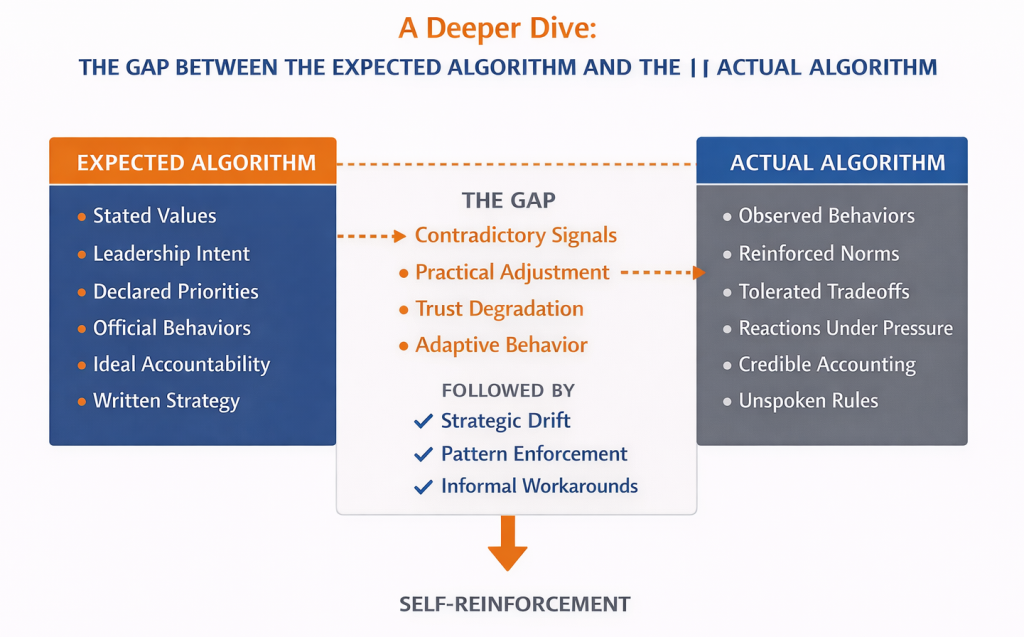
Every leader enters a role with an expected algorithm in mind.
It is rarely written down explicitly, but it is clear in the leader’s thinking. This algorithm includes assumptions about how decisions will be made, how people will behave under pressure, how conflict will be handled, what “good work” looks like, how accountability functions, and how values are meant to show up in daily interactions. It is the mental model the leader believes they are installing.
At the same time, the organization begins constructing a different algorithm. Not the one the leader intended, but the one it actually experiences.
This is the distinction that matters most. Organizations do not run on stated intent. They run on observed behavior. The actual algorithm is built from what people see repeated, reinforced, ignored, tolerated, or quietly rewarded. It is shaped less by what leaders say and more by what happens when those words are tested by time pressure, conflict, ambiguity, or competing priorities.
This gap between the expected algorithm and the actual algorithm is where trust either forms or erodes.
Leaders often underestimate how quickly this gap emerges. In the early weeks of a transition, people are watching closely. They are not evaluating strategy yet. They are pattern-matching. They are paying attention to how meetings are run, how disagreement is handled, who gets listened to, who gets protected, how mistakes are treated, and whether stated values hold under stress.
Small moments matter more than leaders expect. A decision made under urgency. A comment left unaddressed. A behavior that contradicts a stated expectation but carries no consequence. These moments become data points. Over time, they form a coherent picture of how the system actually works.
This is why leaders sometimes feel misunderstood despite clear communication. The organization does not misunderstand the message. It integrates conflicting signals and resolves the contradiction in favor of behavior over language.
When the actual algorithm diverges from the expected one, people adapt. They adjust their behavior to match what they believe is truly required to succeed, stay safe, or avoid friction. This adaptation is rarely cynical. It is usually practical. People learn how the system really functions and respond accordingly.
The most consequential algorithms are rarely enforced formally. They are carried informally by influential individuals and teams who translate leadership behavior into norms. These informal leaders do not need authority to shape the system. They shape it by modeling what works and what does not. Others follow.
Once established, the actual algorithm becomes self-reinforcing. New employees learn it quickly. High performers calibrate to it. Resistance increases when leaders attempt to change outcomes without changing the underlying pattern. At that point, the system appears stubborn or slow, when in reality it is behaving exactly as it has been trained to behave.
This is why later course correction is so difficult. Leaders are not fighting individual resistance. They are attempting to overwrite an operating logic that has already proven reliable to the organization.
The first 90 days matter because they are not just a transition period. They are an initialization phase. This is when the algorithm is being compiled. Early signals carry disproportionate weight. They establish default assumptions that people will rely on long after the leader believes the transition is complete.
This also explains why well-intentioned leaders are often surprised months later. They believe they communicated expectations clearly, yet the organization behaves differently. The disconnect is not confusion. It is coherence. People are following the algorithm that was actually installed.