

Trust is one of the most frequently cited concepts in leadership and business, yet one of the least precisely understood. It is often treated as a moral quality, a personality trait, or an interpersonal preference. Leaders are encouraged to “build trust” in the same way they are encouraged to “be authentic” or “communicate more.” The result is that trust becomes aspirational rather than operational, something leaders hope for rather than something they design.
In practice, trust is not a feeling. It is a condition.
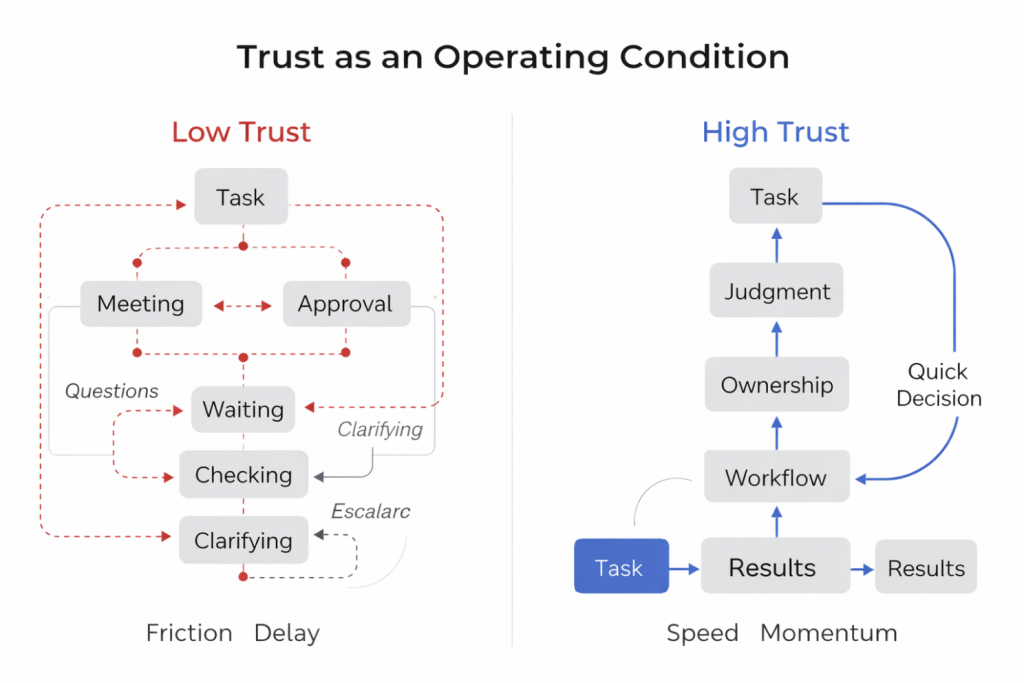
Trust is the condition that determines how people process information, assess risk, decide what to say and what to withhold, and when to act. It shapes whether people engage or protect, whether they move quickly or slow things down, whether they coordinate fluidly or rely on process and permission. Long before trust appears in survey scores or engagement metrics, it appears in behavior. It manifests in how people ask questions, how early problems surface, and how much effort is spent managing risk rather than creating value.
“Trust is the difference between participation and protection.”
This distinction matters because most organizational friction is not technical. It is human. It lives in hesitation, second-guessing, rework, approvals, escalations, and silence. Trust is the variable that determines whether that friction compounds or dissolves.
Leaders intuitively know this, even if they struggle to name it. They feel it when decisions that should be simple take weeks. They feel it when meetings are polite but unproductive, when alignment appears good on paper, but execution lags, and when people comply without committing. These are not failures of intelligence or motivation. They are predictable outcomes of operating in low-trust conditions.
To understand why trust matters so deeply, it helps to look not at what people say about trust, but at what changes when trust is present or absent.
When Trust Changes, the Questions Change
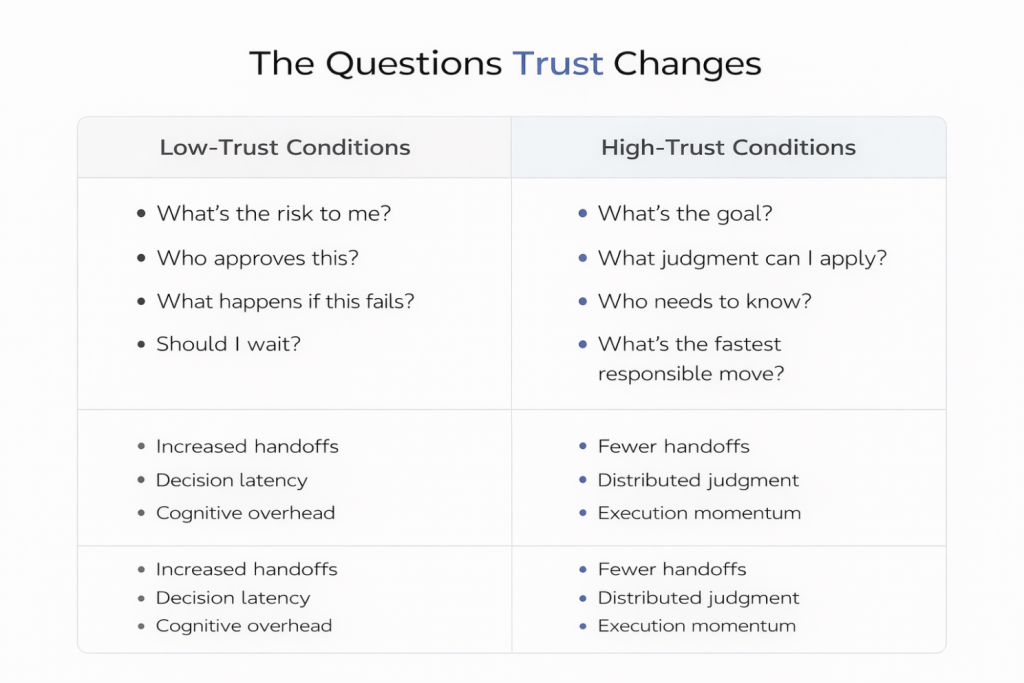
One of the most reliable indicators of trust is not tone or sentiment. It is the nature of the questions people ask.
In low-trust environments, the dominant questions are defensive. People ask, often silently, What is the risk to me? Who will be blamed if this goes wrong? How much information should I share? What is really being asked here? These questions narrow attention and slow coordination. They are not signs of poor character. They are adaptive responses to uncertainty and perceived threat.
In high-trust environments, the questions are generative. People ask, What are we trying to achieve? How can I help? What do you need from me? What’s the fastest responsible way forward? These questions expand attention and speed execution. They signal a shift from self-protection to shared purpose.
“Trust asks different questions.”
This shift is subtle but powerful. It explains why two teams with similar talent and resources can perform so differently. One spends energy scanning for danger, the other spends energy solving problems. The difference is not culture in the abstract. It is trust as a lived condition.
Neuroscience and behavioral research help explain this pattern without reducing it to biology alone. Human nervous systems continually interpret signals of safety and risk in social environments. When signals are ambiguous or threatening, attention narrows, vigilance increases, and people default to caution. When signals are stable and supportive, attention broadens, creativity increases, and coordination becomes easier. Trust acts as a regulator of cognitive load. It determines how much mental energy is spent managing uncertainty versus doing meaningful work.
This is why trust accelerates transactions. In business, deals move faster when parties trust intent and follow through. In organizations, decisions move faster when people trust judgment and fairness. In personal relationships, conversations go deeper when people trust that vulnerability will not be punished. Trust reduces the invisible taxes imposed by uncertainty in every interaction.
Trust and the Hidden Cost of Friction
Every organization has friction. Some of it is necessary. Rules, processes, and checks exist to manage complexity and risk. But much of the friction leaders experience is not designed. It emerges as a compensatory response to low trust.
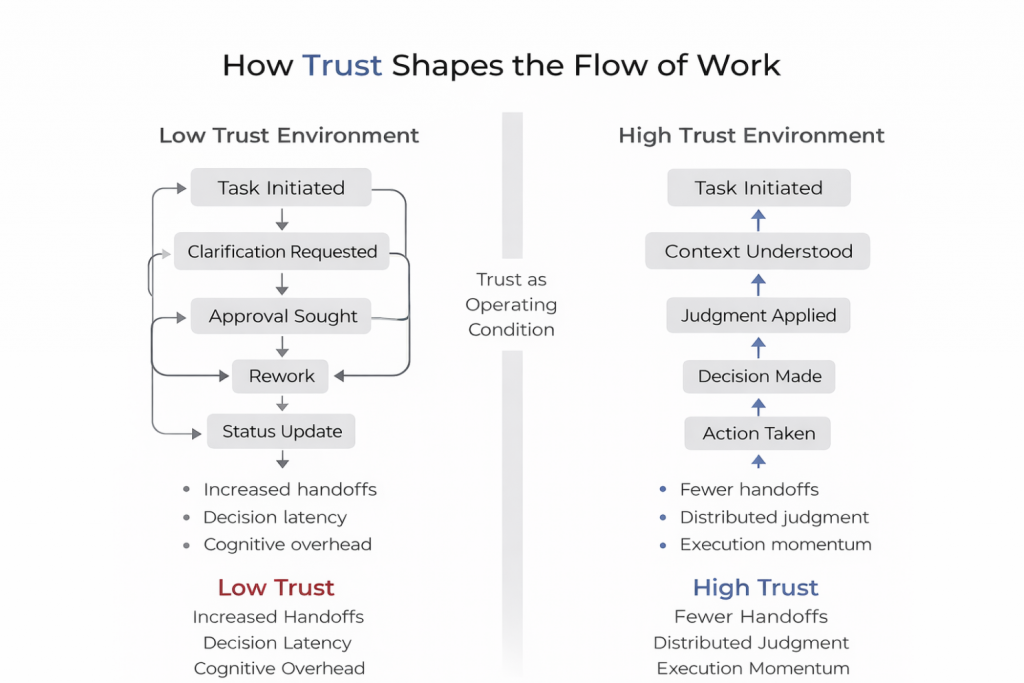
When trust is low, organizations add process. They add approvals, documentation, escalation paths, and oversight. These measures feel responsible, but they are often symptoms rather than solutions. They are attempts to replace confidence with control. Over time, they slow execution and erode ownership, creating the very problems they were meant to prevent.
What makes trust-related friction so difficult to address is that it rarely announces itself. Low-trust environments do not collapse dramatically. They function. Work gets done. Meetings happen. Emails are sent. But everything takes longer than it should. People double-check. They wait for permission. They protect their exposure. Leaders sense that the organization is heavy, but struggle to identify why.
“The absence of trust does not look like failure. It looks like normal work that feels harder than it should.”
Silence is one of the most telling signals in these environments. Silence is often misinterpreted as agreement or apathy. In reality, silence is frequently a sign of perceived risk. When people stop asking questions, stop offering dissent, or stop surfacing problems early, it is rarely because they have nothing to say. It is because they have learned, consciously or unconsciously, that speaking up carries a cost.
Silence is not neutral. It is an adaptive response to the signals an organization sends about safety, fairness, and consequence. It is a decision.
This is why trust is so tightly linked to performance. When trust erodes, people protect themselves. When protection becomes the norm, coordination slows, learning stagnates, and minor issues escalate before they are addressed. Leaders then respond to these failures by tightening control, which further erodes trust. The cycle is familiar and costly.
Why Trust Cannot Be Rushed
One of the most common leadership mistakes is attempting to extract trust before the conditions for trust exist. Leaders announce change, set ambitious goals, and delegate responsibility without first establishing the relational foundation that makes those moves viable. When resistance or hesitation arises, it is often attributed to a lack of commitment or capability.
In reality, trust is sequential. It builds through stages, and those stages cannot be skipped without consequence.
“You can move past trust stages, but you cannot escape their cost. What is skipped early will be paid for later, with interest.”
This insight applies equally in organizations and personal life. People may comply with authority or circumstance, but compliance is not trust. Trust involves a willingness to be vulnerable. That willingness emerges only when people feel safe, understood, and respected over time.
Leaders are often under pressure to move quickly. Speed is rewarded. Urgency is praised. In that context, taking time to build trust can feel indulgent or inefficient. The irony is that skipping trust-building almost always slows things down. It creates friction that surfaces later, when it is more difficult and costly to address.
Understanding why this happens requires shifting the focus from outcomes to conditions. Leaders do not create trust by insisting on it. They create trust by shaping the environment in which people decide whether to trust.
Trust as a Leadership Signal
Leadership is often discussed in terms of vision, strategy, and decision-making. Less attention is paid to the signals leaders send through everyday behavior. Yet these signals are how trust is built or eroded.
How leaders respond to bad news matters more than how they respond to good news. How consistently they follow through matters more than how inspiring they sound. How they behave under pressure matters more than what they say when things are calm.
People do not experience trust as a stated value. They experience it as a pattern. They watch how leaders handle mistakes, how they distribute credit and blame, how they treat dissent, and how they manage uncertainty. Over time, these observations form a working model of what is safe and what is not.
Trust is not created in grand gestures. It is created in small, repeated interactions. This is why trust is fragile early and resilient later. Early signals matter disproportionately because they shape expectations. Once expectations are set, behavior is interpreted through that lens.
This dynamic explains why trust breakdowns often feel sudden but are rarely surprising in hindsight. The signals were there. They were simply overlooked or rationalized.
Trust Beyond the Organization
Although trust is often discussed in organizational contexts, it operates similarly in personal relationships, partnerships, and negotiations. Trust determines whether people bring their full attention and honesty to an interaction or whether they hedge and withhold.
In personal life, trust allows difficult conversations to happen without destroying the relationship. In business, trust allows transactions to proceed without exhaustive safeguards. In both cases, trust reduces the cognitive and emotional load associated with coordination.
The common thread is vulnerability. Trust involves choosing to expose oneself to some degree of risk on the expectation of fair treatment. When that expectation is violated, people adjust their behavior accordingly. They do not stop functioning. They become careful.
Understanding trust as a condition rather than a sentiment helps explain why it matters so much across contexts. Trust enables humans to work together without constant negotiation and defense.
Introducing the KUT Framework
If trust is sequential, then leaders need a way to understand and work with those stages intentionally. This is where the KUT Framework becomes useful.
KUT stands for Know, Understand, Trust. It describes the progression through which trust reliably develops in human systems.
KNOW is the foundation. It is about knowing someone, safety, orientation, and approachability. People need to feel that they can engage without immediate risk. This does not require deep relationships. It requires clear signals that questions are welcome, mistakes are handled fairly, and basic dignity is respected.
- When Know is present, people speak. They ask. They engage. When Know is absent, people scan and protect.
UNDERSTAND comes next. It involves being understood, feeling seen, respected, and confident in the other party’s competence and intent. People need to believe that their constraints are understood, that decisions make sense, and that standards are applied consistently. Understand is where meaning is built.
- Without Understand, people may comply, but they will not commit. They may follow instructions, but they will not take ownership.
TRUST is the final stage. It is characterized by reliability, consistency, and the ability to support under pressure. Trust shows up when people are willing to act without constant oversight, when they surface issues early, and when they take responsible risks. Trust allows autonomy.
- Crucially, Trust cannot be demanded. It is the outcome of honoring the first two stages over time.
“KUT is not a model for persuasion. It is a model for preparation.”
When leaders attempt to operate at the Trust stage without first establishing Know and Understand, they create trust debt. That debt shows up as friction, resistance, and rework. The solution is not more pressure. It is returning to the missing stage and deliberately constructing it.
Why KUT Explains So Many Leadership Failures
Many common leadership challenges can be reframed as stage mismatches.
When leaders complain that people are disengaged or resistant, Know is often missing. People do not feel safe enough to invest emotionally.
When leaders experience compliance without ownership, Understand is often missing. People do not feel respected or confident in the direction.
When leaders find themselves micromanaging despite good intentions, Trust is often missing. Reliability has not yet been proven under real conditions.
Seeing these patterns through the lens of KUT shifts the response. Instead of pushing harder for outcomes, leaders can focus on strengthening the underlying conditions. This is not about being softer. It is about being more effective.
The Real Work of Leadership
The most consequential work leaders do is not setting direction or making decisions. It is shaping the environment in which others decide how much of themselves to bring to the work.
Trust is the condition that determines whether people show up guarded or engaged, whether they ask defensive questions or generative ones, whether they slow things down or speed them up.
Trust reduces friction by reducing the need for protection. It accelerates execution by reducing coordination costs. It transforms silence into signal and participation into momentum.
“The question is not whether trust matters. The question is whether leaders are willing to design for it.”
Trust is built in moments that often feel small. A response to bad news. A decision explained or withheld. A mistake handled fairly or punitively. Over time, these moments accumulate into a pattern, and that pattern becomes the operating condition of the organization.
KUT offers leaders a way to see that pattern clearly and work with it intentionally. It does not promise instant trust. It offers something more valuable: a way to build trust that lasts.
When leaders understand trust as a condition, not a concept, they stop asking how to get people to trust them and start asking how to create environments worthy of trust.
